What Are We Really Removing With AI?
skip render: ucaddon_dual_color_heading Why AI is So Affordable Right Now Construction AI Lab helps busy construction professionals stay ahead of



Construction AI Lab helps busy construction professionals stay ahead of a fast-moving AI world.We watch what is changing, connect the dots, and explain what is likely to be coming next.Construction AI Lab is a no-cost initiative of sudyco®.
State of Construction AI
Weekly Conditions, Signals, and Insights
Week of August 31, 2026
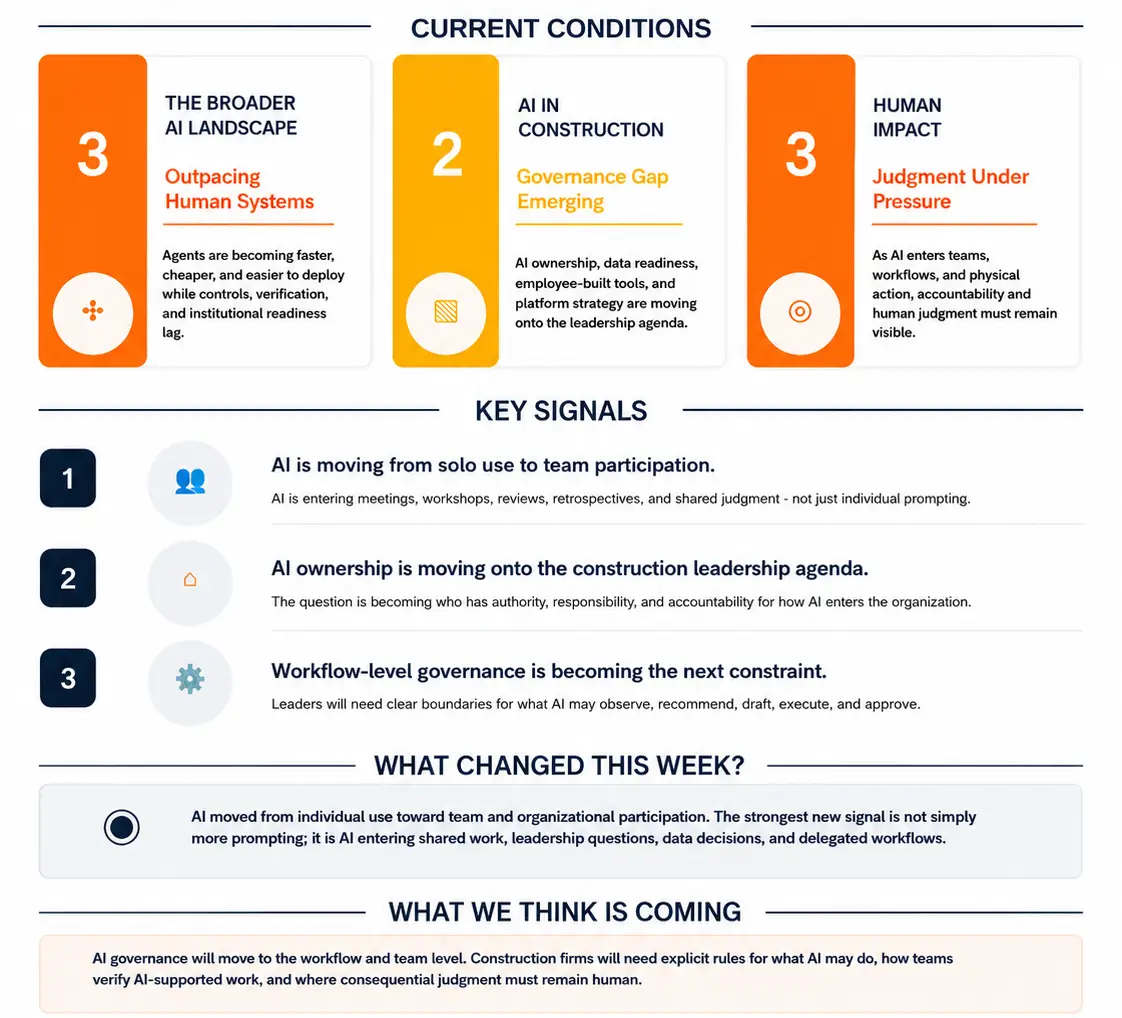
New to the State of Construction AI? Learn how we assess these conditions →
The Big Question
The AI Questions Are Changing.Are Construction Leaders Asking the New Ones Yet?
Why the most important AI questions has moved from capability to consequence.
Dear Sue,
I listened to a recent AI news episode that compared the way people were talking about AI a year ago with the questions they are asking now. What struck me was how much more sophisticated the questions have become. A year ago, it felt like people were asking what AI could do. Now they seem to be asking what AI is doing to work, judgment, expertise, and organizations. That seems right to me. Is that what you are seeing too?
— Noticing the Shift
Dear Noticing,
Yes. And I think your instinct is important.
One of the clearest signs of any major technology transition is not just the technology itself. It is the quality of the questions people start asking after the first wave of excitement, fear, experimentation, and confusion begins to settle.
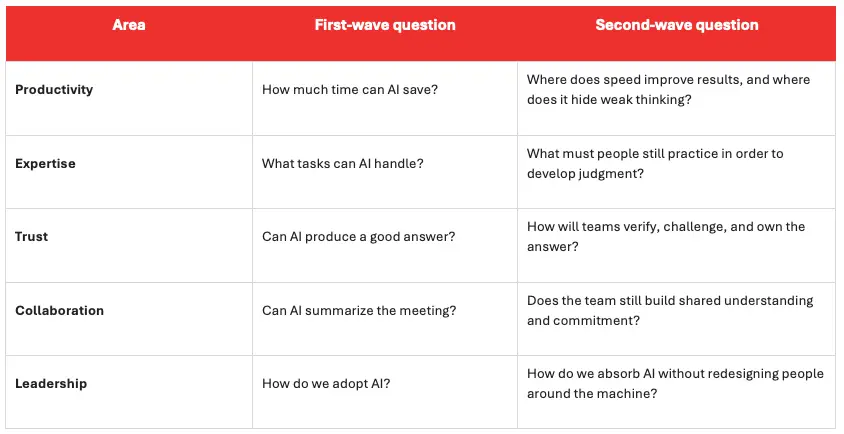
In the early phase of generative AI, many of the questions were naturally tool-centered. What can it write? Can it summarize? Can it search? Can it code? Can it replace this task? Can it automate that workflow? Can it make us faster?
Those were reasonable first questions. Construction leaders, like leaders in every industry, needed to understand what this new capability was and where it might fit. But those questions were only the beginning.
The harder questions are emerging now because people are no longer looking at AI from a distance. They are living with it. They are seeing its usefulness, its limits, its distortions, and its effects on the way people think and work together.
The Big Question
If the AI questions are changing, are construction leaders changing their questions fast enough?
The first phase was about capability
The first wave of AI conversation was dominated by possibility. The tools were startling. A person could ask for a draft, a summary, a comparison, a plan, a code sample, a risk list, or a meeting agenda and receive something useful in seconds. For busy project leaders, that was not abstract. It was practical.
So the conversation naturally began with capability: What can AI do for us? Where can it save time? Which tasks are repetitive enough to automate? How do we write better prompts? Which tools should we test?
Those questions still matter. Construction has enormous amounts of administrative burden, fragmented communication, inconsistent documentation, and repeated knowledge work that drains time from project teams. AI can help with many of those problems.
But when the questions stay only at the level of capability, leaders can miss the deeper transition. AI does not simply add a tool to the work. It enters a human system. It changes who drafts, who checks, who learns, who decides, who is accountable, and what people stop practicing.
The second phase is about consequence
A recent episode of The AI Daily Brief described this shift well. The episode framed AI as a technology that is solving old problems while creating new ones, including AI slop, rising token costs, uneven productivity, workforce deskilling, and the long-term challenge of preserving human expertise. The point is not that AI is bad. The point is that the conversation has matured.
People are no longer only asking, “Can AI do this?” They are asking, “What happens when AI does this at scale?”
That is a very different question.
It is the difference between asking whether a tool can produce a meeting summary and asking what happens when fewer people learn to listen carefully, synthesize discussion, detect weak commitments, and notice what was not said.
It is the difference between asking whether AI can draft an RFI and asking whether junior staff still learn the reasoning, field context, contract awareness, and judgment required to know whether the draft is correct.
It is the difference between asking whether AI can generate a risk register and asking whether the project team still has the conversation that builds shared understanding, commitment, and accountability around those risks.
The second phase is not anti-AI. It is more serious than that. It is the phase where leaders begin to ask how AI changes the human system around the work.
Construction should pay close attention to this shift
Construction is not a purely digital industry. It is a human, physical, contractual, operational, and relational industry. Projects succeed or fail through judgment, trust, coordination, field awareness, communication, timing, and the ability of people from different organizations to solve problems together under pressure.
That means AI cannot be evaluated only by whether it makes an individual task faster. A faster task is not always a better project outcome. A cleaner document is not always a better understanding. A more polished answer is not always a more reliable decision.
For construction leaders, the next AI questions need to be system questions.
From first-wave questions to second-wave questions
The most important shift: from answers to reasoning
Another important signal comes from research highlighted in the same AI conversation: the most effective AI users do not treat AI merely as an answer machine. They use it as a reasoning partner. They frame the problem, define the audience, provide context, ask the model to explain its thinking, challenge weak answers, iterate, and decide what to trust.
That distinction matters deeply for construction.
A project manager who uses AI to draft a letter without understanding the contract, the facts, the relationship history, and the downstream consequences has not gained capability. That person may have gained speed while weakening judgment.
But a project manager who uses AI to test multiple interpretations, identify missing facts, prepare for a difficult conversation, compare options, and sharpen a final decision may be developing better judgment. The same tool can either substitute for thinking or strengthen thinking. The difference is how the human uses it.
That is why “AI literacy” cannot mean only prompt tips. It has to include problem framing, verification, accountability, ethical judgment, domain knowledge, and the discipline to stay engaged when the machine sounds confident.
The risk is not only that AI will make mistakes
Construction leaders already understand the risk of bad information. A wrong quantity, missed condition, vague commitment, inaccurate schedule update, or poorly documented issue can become expensive very quickly.
But the deeper AI risk may be more subtle. The risk is that people may gradually stop doing the kinds of work that build expertise.
If AI always writes the first draft, junior people may get fewer repetitions in organizing their thoughts. If AI always summarizes meetings, people may pay less attention to the dynamics in the room. If AI always produces the risk list, teams may skip the hard discussion that turns risk awareness into coordinated action. If AI always provides the answer, people may stop building the confidence to challenge it.
Expertise is not downloaded. It is developed through repeated cycles of noticing, thinking, deciding, acting, receiving feedback, and adjusting. Construction leaders should be very careful about automating away the repetitions that create capable people.
Leadership Checkpoint
Do not ask only, “What work can AI take off our plate?” Also ask, “What human capability is built by doing this work, and how will that capability be preserved?”
A better AI conversation for construction leaders
The next stage of AI leadership in construction should not be driven by hype or resistance. It should be driven by better questions.
Here are five questions construction leaders should be asking now:
1. Where is AI improving project outcomes, not just making individual tasks faster?
2. Which uses of AI strengthen human judgment, and which ones allow people to bypass judgment?
3. What must junior people continue to practice so they develop into capable project leaders?How will teams verify 4. AI-assisted work before it becomes part of the project record?
5. Where must human accountability remain explicit, visible, and non-delegable?
These questions move the conversation from adoption to stewardship. They do not slow the industry down. They help the industry absorb AI in a way that protects performance, trust, and human capability.
The new measure of AI maturity
A year ago, an organization might have seemed mature because it had access to AI tools, a pilot program, a prompt library, or an innovation committee.
Those things may still be useful, but they are not enough.
The more mature organization is the one asking better questions: What is happening to our work? What is happening to our people? What is happening to our judgment? What is happening to our trust? What is happening to our ability to learn?
For construction, that is where the real AI conversation begins.The goal is not to resist AI. The goal is not to worship it. The goal is to make sure AI serves the human system that has to deliver the project.
So yes, the questions are changing. And that is a good sign.It means the conversation is growing up.
The question now is whether construction leaders will grow up with it.
— Sue
SOURCE NOTES
Sparked by the August 16, 2026 episode of The AI Daily Brief, “The New Problems AI Is Creating (And How People Are Solving Them),” and KPMG/University of Texas at Austin research on sophisticated AI use and AI as a reasoning partner.
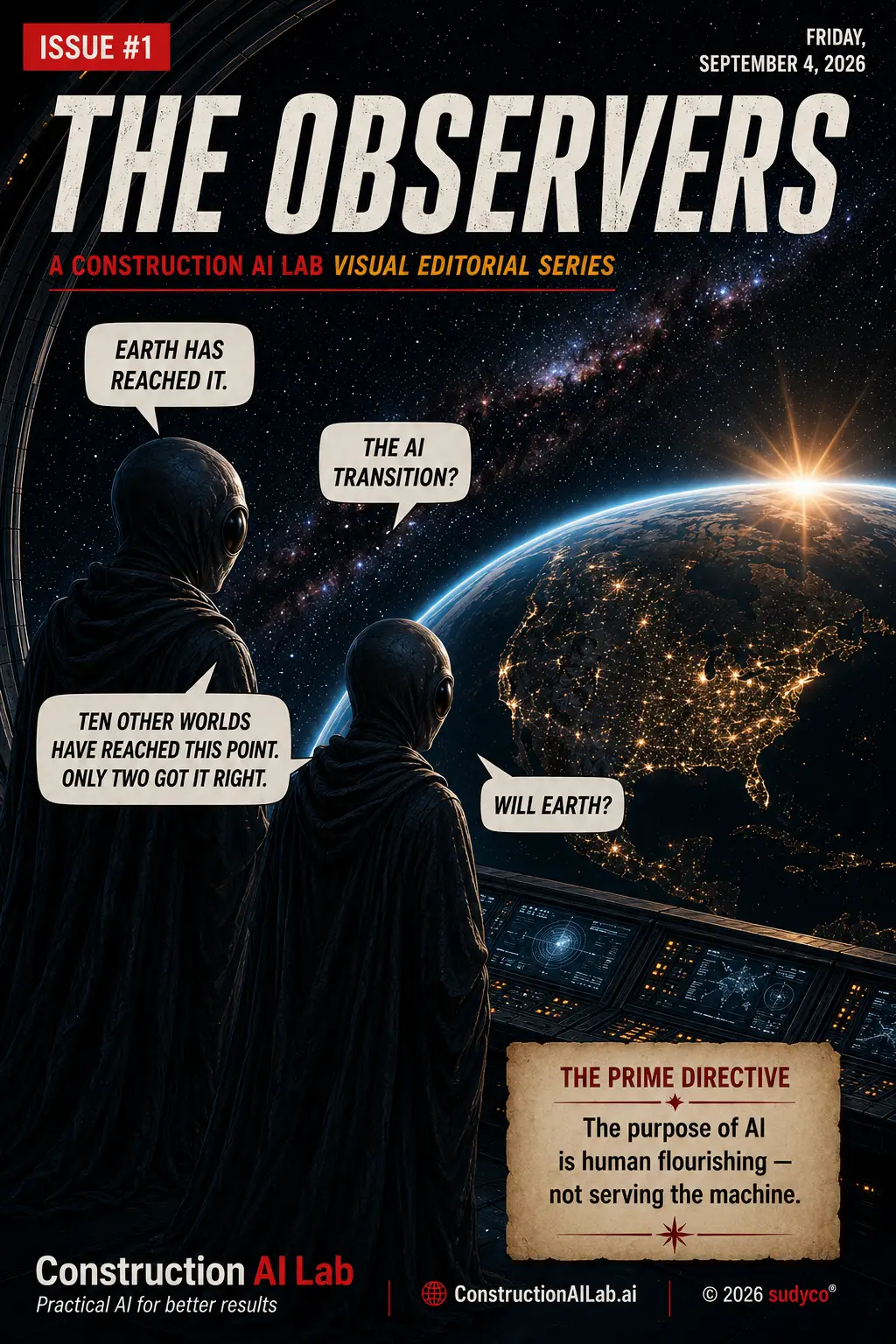
The Observers
Construction AI Labs Graphic Editorial
What's New?
Guide: AI-Driven Change Absorption Guide
New from Construction AI Lab: The AI-Driven Change Absorption Guide
AI is moving fast. But organizations are human systems—and human systems can only absorb so much change at one time.
That is the idea behind our new AI-Driven Change Absorption Guide, a practical framework and assessment for construction leaders who are trying to capture the value of AI without overwhelming the people, judgment, relationships, and operating systems that make performance possible.
The Guide introduces a simple question:
Is AI-driven change entering the organization faster than the human system can absorb, adapt, and recover?
Using the sponge as a visual metaphor, the framework makes that invisible dynamic easier to see. Every organization has finite absorption capacity. That capacity is shaped by human capability and learning, responsibility and authority, governance and resilience, culture and human-system health, and the ability to learn and adapt.
The Guide then turns the idea into something leaders can actually use. It includes a practical assessment to compare change pressure with absorption capacity, identify early signs of strain, determine where the system is most vulnerable, and decide whether enough capacity has recovered before introducing the next significant wave of AI-driven change.
This is not an argument for less AI.
It is an argument for sustainable progress—moving at a pace that allows organizations to gain the benefits of AI while preserving judgment, accountability, resilience, trust, and the ability to keep learning.
The goal is not slower AI. It is better absorption.

Did this help you? Have a question? Or willing to share how you're using AI in the field? Let us know — and your question or story may be featured in a future issue of Construction AI Lab. Email: [email protected] | Subject line: Dear Sue
ABOUT THE AUTHOR
Sue Dyer is a construction industry leader, Wall Street Journal bestselling author of The Trusted Leader, and a pioneer of Partnering. Through Construction AI Lab, she helps construction leaders make sense of AI—what’s working, what’s not, and what is most important. Contact [email protected]
This publication is provided for educational and informational purposes only and does not constitute legal, cybersecurity, technical, or professional advice. Organizations should evaluate their own operational, legal, security, and governance requirements when implementing AI technologies. AI systems, policies, and industry practices continue to evolve rapidly. Construction AI Lab and sudyco® make no guarantees regarding specific outcomes, compliance, or risk mitigation associated with the use of AI technologies.
© 2026 Construction AI Lab, an initiative of sudyco®
Built for the Industry. Meant to be Shared. You Have Our Permission.