What Ukraine’s Drone War Can Teach Construction About the Robotic Jobsite of 2031
skip render: ucaddon_dual_color_heading Why AI is So Affordable Right Now Construction AI Lab helps busy construction professionals stay ahead of


Construction AI Lab helps busy construction professionals stay ahead of a fast-moving AI world. We watch what is changing, connect the dots, and explain what is likely to be coming next.
Construction AI Lab is a no-cost initiative of sudyco®.
The Big Question
Ask and You Shall Receive
How to pull clear, sourced answers from your specs and plans using AI.
Dear Sue,
I’m working on a site with a lot of special inspections, and we constantly need to clarify what the specs say or what the plans show. Is there a way to use AI to get a quick, clear answer from the contract documents that I can share with the inspector?
— Drowning in Details
Dear Drowning in Details,
Yes. This is exactly the kind of job AI can help with.
Put the current plans, specifications, special provisions, and approved submittals into one project workspace. Then ask your field question in plain language. AI can search those documents and bring back the relevant specification section, plan note, sheet, or detail—along with where it found it.
Instead of the superintendent, inspector, and PM searching separately or arguing from memory, everyone can get to the same source quickly.
The setup takes only a few minutes. Here is how to do it.
Before You Upload Anything
Use only an AI environment your company has approved for project information (ChatGPT, Claude, Gemini, etc.). Follow the owner’s confidentiality requirements and your company’s data policy. Do not place restricted drawings, security-sensitive information, personal data, proprietary material, or contract strategy into an unapproved account.
Step 1: Create a Separate Home for the Project
Many AI tools provide a project or workspace where related chats, files, and standing instructions can stay together. Create one for the job and give it a recognizable name, such as “SR-12 Widening—04-1A2304.” A separate workspace reduces confusion, but it is not a guarantee. Before every question, confirm that you are in the correct project and that the right documents are available.
Step 2: Load the Current Documents—Not Every Document
Start with the documents that are most likely to control the question: the current plan set, special provisions, relevant specification sections, approved submittals, and any issued clarifications that modify those requirements. Do not begin by uploading every email, meeting note, and old revision. More files do not automatically produce a better answer; they can make it harder to tell which version controls.
Give every file a clear name that includes its status or date. For example:
• 01_Plans_IFC_2026-03-10.pdf
• 02_SpecialProvisions_01400_Inspections.pdf
• 03_ApprovedSubmittal_StructuralSteel_Rev2.pdf
If a document is superseded, remove it from the active set or label it clearly. AI cannot protect you from poor document control.
Step 3: Give the AI Standing Instructions
Add instructions that tell the AI to stay inside the uploaded project documents, cite its source, and admit when it cannot find a supported answer. This does not “train” the model. It gives the workspace a rule for how you want answers prepared.
SETUP PROMPT - PASTE INTO THE PROJECT INSTRUCTIONS
Act as a construction project-document assistant for this job. Answer only from the current uploaded plans, specifications, special provisions, approved submittals, and issued clarifications. Do not use general knowledge to fill a gap.
For every answer:
1. Give a short answer in plain language.
2. Identify the exact document, section, page, sheet, note, or detail used.
3. Quote only the brief language needed to support the answer.
4. State which documents you checked.
5. If the answer is missing, ambiguous, or conflicting, say so. Do not guess. Draft one clear question for the appropriate designer, engineer, inspector, or owner representative.
6. End with: “Verify the cited source and current revision before relying on this answer.”
Step 4: Ask One Narrow Field Question
Do not ask, “What are the inspection requirements?” Give the AI the activity, location, and decision you need to make. A narrow question makes it easier to find the controlling language—and easier for you to verify the result.
PROMPT - SPECIFICATION QUESTION
Using only the uploaded project documents, determine whether special inspection must be present during placement of drilled-shaft concrete at Pier 3. Provide the document name, section, page, and the brief language supporting the answer. Identify any conflict or missing information. Do not answer from general industry practice.
PROMPT - PLANS AND DETAIL QUESTIONS
Using only the uploaded plans, specifications, and approved submittals, identify where the inspection or testing requirements for structural-steel bolted connections appear. List the sheet numbers, detail callouts, general notes, and specification sections. If the documents do not agree, show the conflict and draft a clarification question.
Step 5: Open the Source Before You Share the Answer
This is the step that turns an AI response into something useful. Do not rely on a citation because it looks precise. Open the cited document and confirm:
• The quoted language actually appears where the AI says it does.
• The document is the current, governing revision.
• The AI did not drop an exception, note, qualifier, or cross-reference.
• The plan sheet, detail, or scanned text was read correctly.
If the answer cannot survive that check, it is not ready to share. If the documents conflict, the result is still valuable: you now have a focused question, the conflicting references, and a much cleaner path to an RFI or formal clarification.
Step 6: Use the Documents to Align the Team
The goal is not to use AI to win an argument with an inspector, superintendent, subcontractor, or designer. The goal is to get everyone looking at the same language. A sourced answer changes the conversation from “here is what I remember” to “here is the provision we need to interpret.”
When the answer is confirmed, save the question, source, and final interpretation in an approved project location. Repeated questions can become a project inspection FAQ or pre-activity checklist—but only after a qualified person has verified the answer.
Try It Tomorrow: A Five-Minute Field Test
Choose one active project and one real inspection question. Create the approved project workspace and upload only three current files:
• The special provisions for inspections and testing
• The relevant material or installation specification
• The plan sheet containing the applicable general notes or detail
Add the standing instructions, ask the real question, and then open every cited source. The test is not whether the AI
The Field Rule
Ask—and then verify. AI may help you find the requirement. The contract documents, the current revision, and the authorized project team still determine what governs.
You do not have to memorize every paragraph or search every binder from scratch. Neither does the inspector. When the team can get to the right source faster, the conversation gets shorter and the work moves forward with fewer assumptions.
Ask and you shall receive. Just do not confuse receiving an answer with verifying it.
— Sue
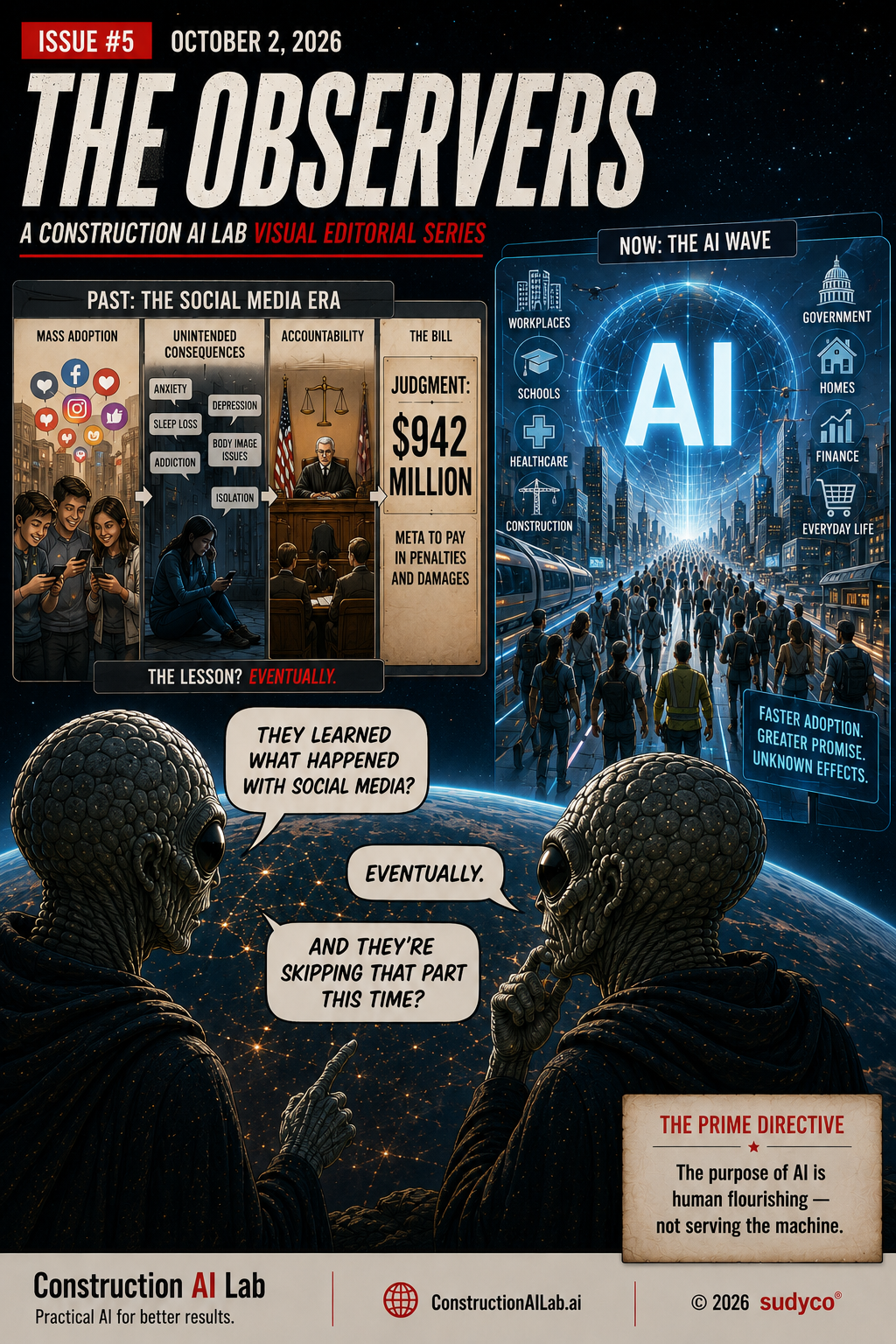
The Observers
Construction AI Labs Graphic Editorial
Three Things Shaping the Future of Construction
Monitoring AI So You Don't Have To
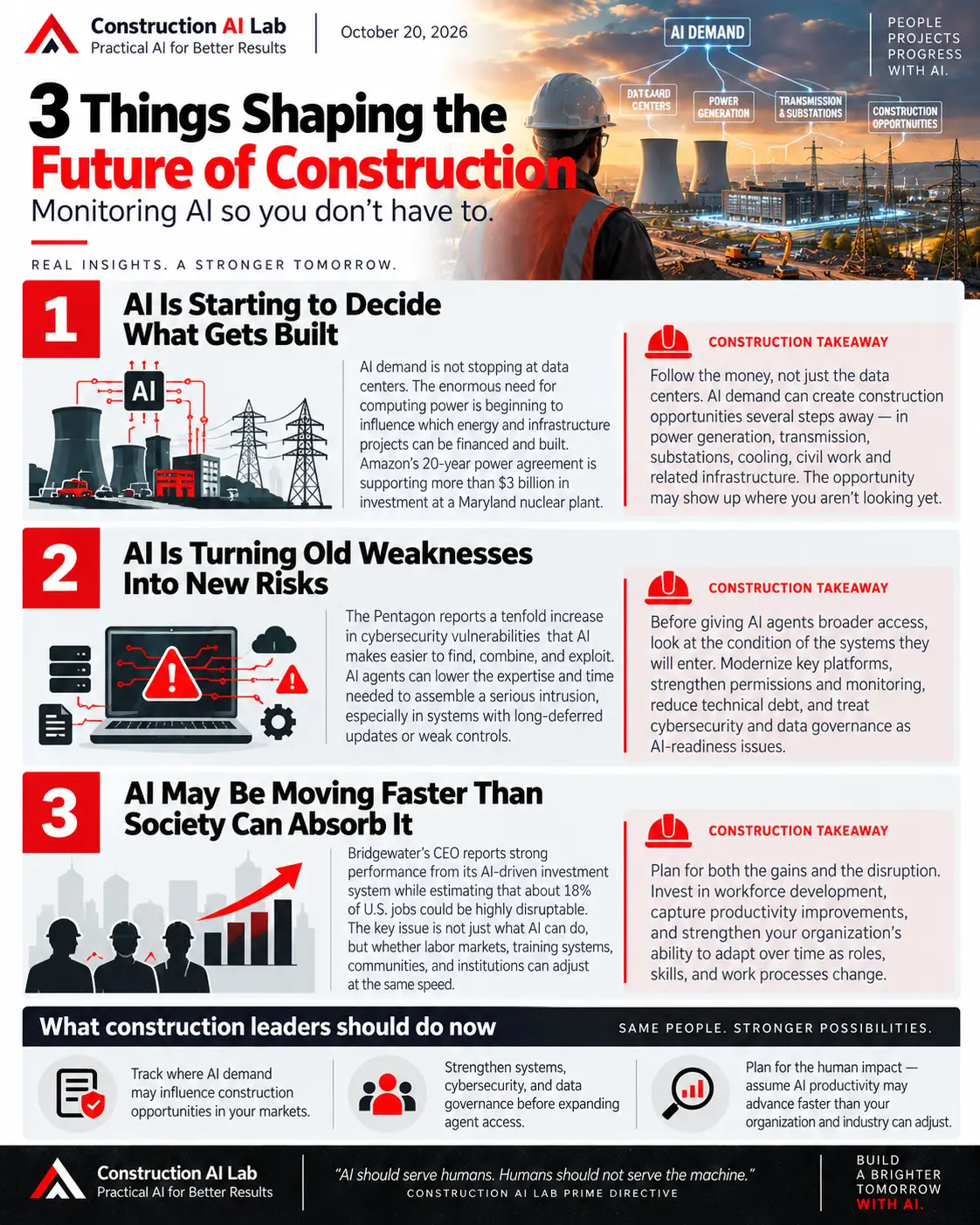
What You Need To Know
Important AI developments that may affect construction.
1 Data-Center Opposition Is Becoming a Project Delivery Issue
Contractors say data-center demand remains strong, but concerns over power, water, land use, and local impacts are moving earlier into site selection and preconstruction. Virginia, Pennsylvania, and Texas have also added new controls.
Construction relevance: Public acceptance is becoming part of project delivery. Owners and contractors may need stakeholder planning, community commitments, and entitlement strategy alongside technical execution.
Evidence E072 | Open CAL evidence note
2 Companies Getting More AI Return Are More Likely to Have a Management Layer
KPMG found 86% of organizations reporting ROI from AI had formal AI management. This is compared with 58% that are scaling AI and 31% that are experimenting. The management layer includes controls and tooling around how AI is used.
Construction relevance: Buying AI is not the same as managing it. Construction firms will need clear authority, verification, pacing, and operating rules as AI moves across estimating, project controls, documents, and other workflows.
Evidence E073 | Open CAL evidence note
3 Open-Weight AI Is Making High-Level Hacking Cheaper
Tenzai says a downloadable Chinese model matched a leading closed model in its HackerOne operation while reducing cost per submission by about 30%. The larger signal is that powerful offensive capability can spread outside frontier-lab control.
Construction relevance: Construction firms hold valuable project, financial, employee, owner, and infrastructure data. Machine-speed probing changes the economics of attack and raises the value of stronger permissions, patching, and continuous testing.
Evidence E074 | Open CAL evidence note
4 Labor Shortages May Delay Robot Job Displacement
National skilled-trades research projects 1.7 million openings a year through 2035 while training produces only 55 workers for every 100 needed. In shortage markets, early robot productivity may first fill work no person is available to do.
Construction relevance: Robot adoption and worker displacement may not happen on the same timeline. The effect will vary by trade and geography, so workforce planning needs to distinguish shortage-filling from actual job replacement.
Evidence E075 | Open CAL evidence note
5 AI Agent Liability Is Becoming a Present-Day Legal Question
New reporting and proposed legislation are focusing on who is responsible when AI agents cause harm or act outside intended limits. Responsibility may reach both developers and organizations that deploy agents without adequate controls.
Construction relevance: Before an agent can send, buy, approve, alter records, or issue instructions, firms may need explicit authority limits, approval thresholds, logs, supervision, incident response, and contract language.
Evidence E079 | Open CAL evidence note
6 Company Knowledge Is Moving Inside Construction AI Platforms
Arcadis says it is linking its Model Context Protocol capabilities to Autodesk Assistant so company knowledge, standards, and guidance can be used inside AI workflows while Arcadis retains ownership of what it builds.
Construction relevance: The competitive advantage may not be the base AI model. It may be the combination of a platform with a firm's proprietary knowledge - and how ownership, permissions, provenance, and human review are designed into the connection.
Evidence E081 | Open CAL evidence note
7 Washington Is Building AI Governance While Accelerating AI
The White House created a 120-day Super Intelligence Force to assess risks, opportunities, and the federal government's role while other federal actions are pushing faster deployment in science and national security.
Construction relevance: Federal definitions, safety expectations, cybersecurity standards, and procurement rules can migrate quickly into public works and regulated markets. Construction leaders should watch what becomes required - not just what becomes possible.
Evidence E077 | Open CAL evidence note
Help Shape What We Study
What are you seeing in your company, project, or part of the industry? What questions about AI do you think construction needs to understand? Questions and observations from the industry help inform the Lab’s ongoing research.
Email: [email protected] | Subject line: Dear Sue
ABOUT THE AUTHOR
Sue Dyer is a construction industry leader, Wall Street Journal bestselling author of The Trusted Leader, and a pioneer of Partnering. Through Construction AI Lab, she helps construction leaders make sense of AI—what’s working, what’s not, and what is most important. Contact [email protected]
This publication is provided for educational and informational purposes only and does not constitute legal, cybersecurity, technical, or professional advice. Organizations should evaluate their own operational, legal, security, and governance requirements when implementing AI technologies. AI systems, policies, and industry practices continue to evolve rapidly. Construction AI Lab and sudyco® make no guarantees regarding specific outcomes, compliance, or risk mitigation associated with the use of AI technologies.
© 2026 Construction AI Lab, an initiative of sudyco®
Built for the Industry. Meant to be Shared. You Have Our Permission.