Two Minute Daily Logs
skip render: ucaddon_dual_color_heading Why AI is So Affordable Right Now Construction AI Lab helps busy construction professionals stay ahead of



Construction AI Lab helps busy construction professionals stay ahead of a fast-moving AI world. We watch what is changing, connect the dots, and explain what is likely to be coming next.
Construction AI Lab is a no-cost initiative of sudyco®.
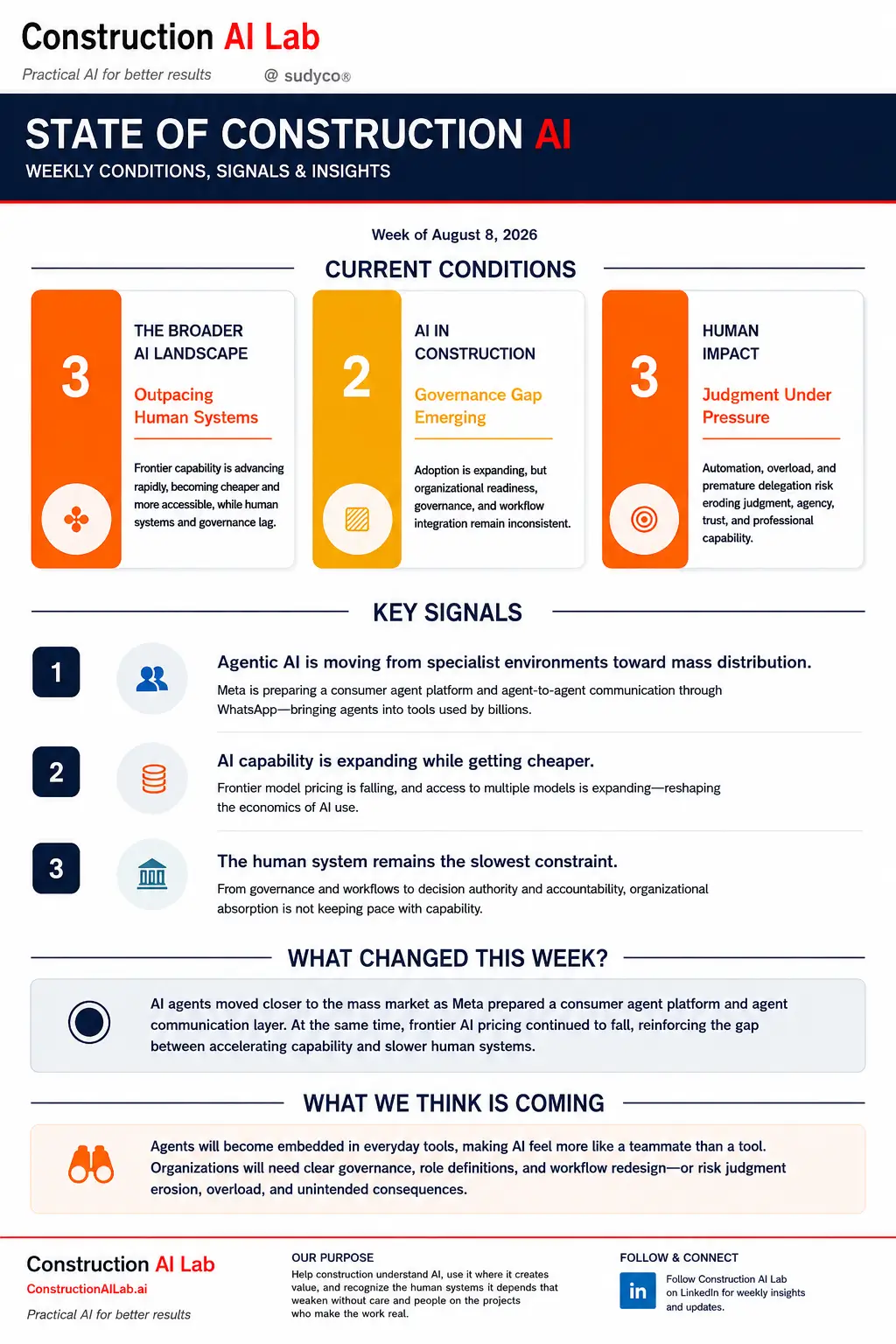
State of Construction AI
Weekly Conditions, Signals, and Insights
Week of September 7, 2026
New to the State of Construction AI? Learn how we assess these conditions →
The Big Question
What Are We Really Removing With AI?
Efficiency gains can quietly reduce the human capacity an organization will need for the next wave of change.
Dear Sue,
We are starting to use AI to do more work with fewer people. That looks like efficiency. But how do we know when we are cutting away people we will actually need later?
— Trying to Get Leaner Without Getting Weaker
Dear Trying to Get Leaner Without Getting Weaker,
That may be one of the most important questions construction leaders can ask as AI moves from experimentation into everyday work.
The obvious promise of AI is productive capacity: more work completed, faster analysis, fewer repetitive tasks, and less administrative burden. Those benefits are real. But there is another capacity leaders need to watch just as carefully—the human system’s capacity to absorb the next wave of change.
An Organization Is Not Just Headcount
Think of an organization as a sponge. The sponge is made up of people, but what gives it absorptive strength is more than the number of people on the payroll. It includes experience, judgment, mentoring, relationships, redundancy, institutional memory, the ability to challenge a decision, and the people who know how the work actually gets done.
When AI removes repetitive work and gives people more time to think, solve problems, and work ahead, the sponge can become stronger. But when organizations respond to every efficiency gain by immediately removing human capacity, something different can happen: the sponge itself begins to shrink.
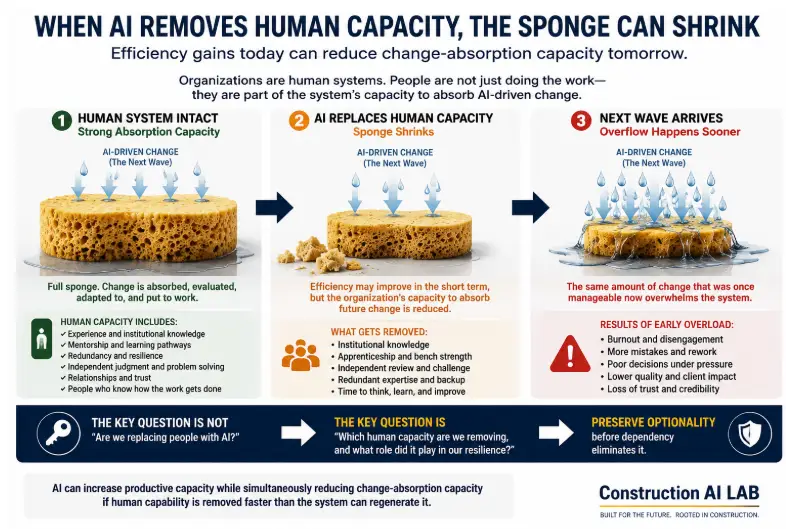
Figure 1. When AI removes human capacity, the organization may reach overload sooner when the next wave of change arrives.
What the Graphic Is Showing
The first sponge represents a human system with strong absorption capacity. It has room to take in change because knowledge, judgment, learning pathways, relationships, and backup capacity are still present.The second sponge is intentionally only somewhat smaller. That matters. The risk is not limited to massive layoffs. A relatively modest reduction can have an outsized effect if the capability removed was carrying something the system depended on—an experienced superintendent who coaches three younger leaders, an estimator who recognizes unusual risk, a project engineer role that develops future project managers, or a second reviewer who catches what the first person misses.
The third sponge shows what becomes visible later. Another wave of AI-driven change arrives. The amount of change may be no greater than before, but the organization has less human capacity available to absorb it. Saturation occurs sooner. The short-term efficiency decision has changed the system’s future resilience.
The key question is not: “Are we replacing people with AI?” The better question is: “Which human capacity are we removing, and what role did it play in our resilience?”
A Construction Example
Imagine a contractor introduces AI tools that dramatically reduce the time needed for project documentation, scheduling updates, correspondence, and routine analysis. The productivity gain is immediate. Leadership concludes that the same volume of work can now be handled with fewer people.
On paper, the math works.But six months later, the organization takes on several new projects while introducing another generation of AI tools. Suddenly the remaining team is trying to learn new systems while delivering live work. Senior people have less time to coach. Junior people have fewer opportunities to develop foundational judgment because the AI performs much of the work they once learned by doing. Independent review becomes thinner. A few experienced people become critical bottlenecks.
Nothing necessarily failed because the AI was bad. The organization may simply have reduced the human capacity that allowed it to absorb change without becoming brittle.
Efficiency and Resilience Are Not the Same Thing
This is where leaders need to separate two measures that can easily be confused. Productive capacity asks: How much work can we accomplish? Change-absorption capacity asks: How much new change can this human system understand, integrate, and sustain without degrading performance, judgment, trust, or resilience?AI can increase the first while reducing the second. That does not mean organizations should keep unnecessary work or preserve every role exactly as it exists today. It means leaders need to understand the system function being removed before they remove it.
Some apparent inefficiency is actually resilience. Overlapping knowledge may look redundant until the only expert leaves. Junior work may look automatable until there is no longer a pathway for developing senior expertise. A second review may look expensive until the organization discovers that nobody is independently challenging an AI-assisted conclusion.
Before You Remove the Human CapacityBefore converting an AI efficiency gain directly into a workforce reduction, construction leaders can ask five practical questions:
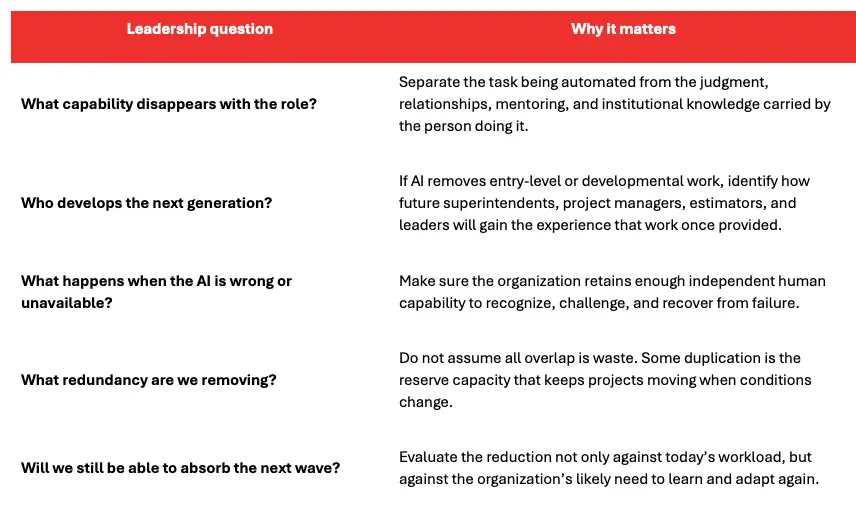
Preserve Optionality Before Dependency Eliminates It
The point is not to slow AI adoption or protect work simply because it has always been done by people. The point is to avoid trading away capabilities that will be expensive—or impossible—to rebuild once the organization depends on AI to provide them.
The safest efficiency gain is one that improves today’s performance while preserving enough human capability to adapt tomorrow.
A useful leadership test: If we needed to rebuild this human capability three years from now, could we? If the answer is no, treat its removal as a strategic decision—not merely a productivity decision.
The Larger Lesson
The AI transition will not happen in one implementation. It will arrive in waves. Each wave will alter roles, workflows, expectations, authority, and the skills people need. Organizations that consume their human capacity after every productivity gain may eventually discover that they have become highly efficient at today’s work and poorly equipped for tomorrow’s change.
That is why the sponge matters. It reminds us that people are not simply inputs to be optimized. They are part of the organization’s ability to learn, adapt, recover, and remain resilient.
AI should help strengthen that capacity—not quietly remove the very material the organization will need for what comes next.
Dear Trying to Get Leaner,
Use AI to remove friction. Use it to increase productive capacity. But before you remove people, look beyond the task AI has taken over and ask what human capacity that person was carrying for the larger system. Efficiency is valuable. Resilience is what allows the organization to keep creating value when the next wave arrives.
— Sue
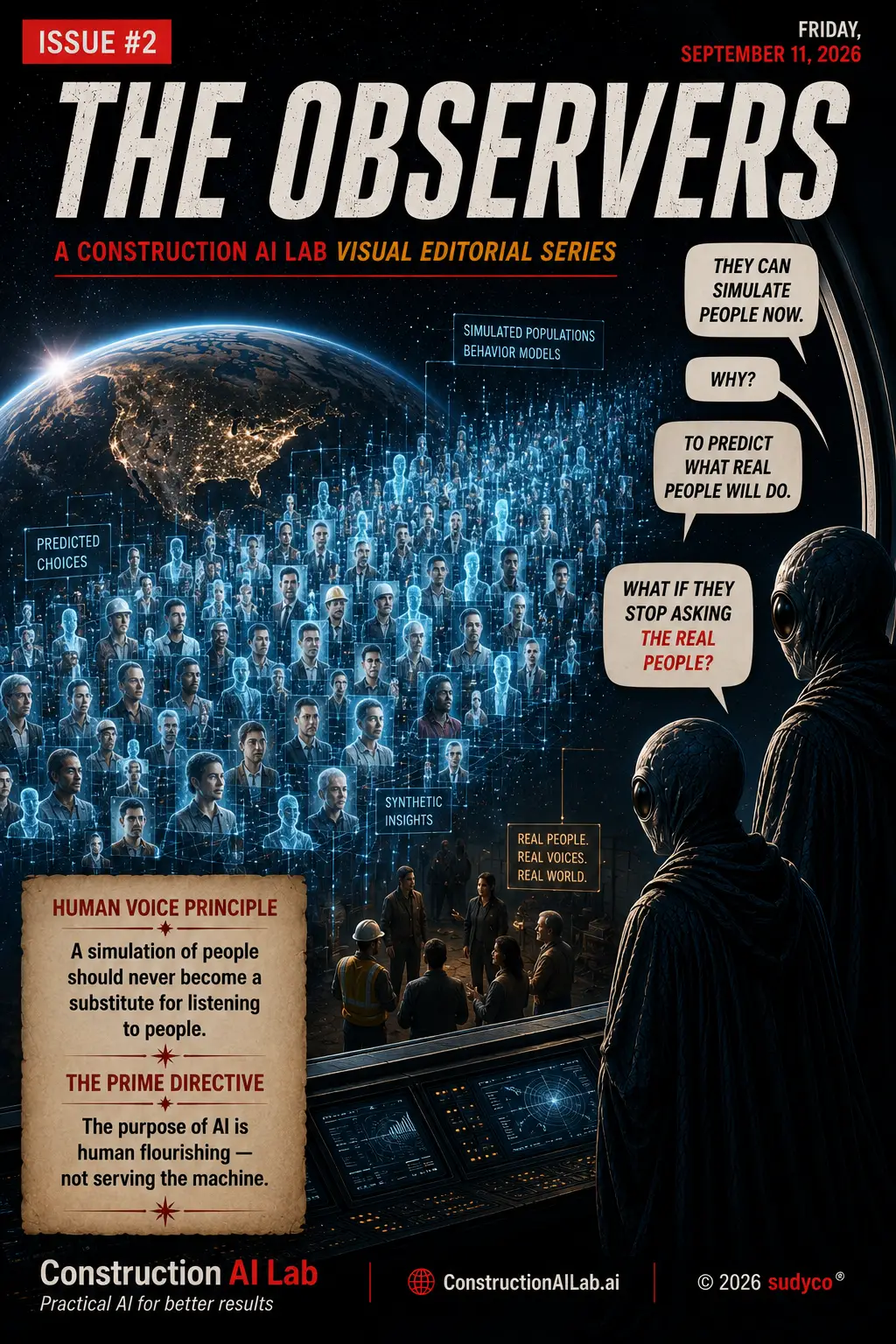
The Observers
Construction AI Labs Graphic Editorial
What's New?
Standard: Organizational AI Integration and Technical Guidance for AI Integration
One of the problems I see with AI right now is that the technology is moving much faster than most organizations can figure out how they want it to work inside their company.
So we decided to create something practical.
The Construction AI Lab Organizational AI Integration Standard is a starting point construction companies can actually use and adapt.
We also created companion Technical Guidance for AI Integration to help leadership, IT, security, legal, risk, HR, records, and operations work through those questions together.Both are practical resources. Both are meant to be adapted.
Did this help you? Have a question? Or willing to share how you're using AI in the field? Let us know — and your question or story may be featured in a future issue of Construction AI Lab. Email: [email protected] | Subject line: Dear Sue
ABOUT THE AUTHOR
Sue Dyer is a construction industry leader, Wall Street Journal bestselling author of The Trusted Leader, and a pioneer of Partnering. Through Construction AI Lab, she helps construction leaders make sense of AI—what’s working, what’s not, and what is most important. Contact [email protected]
This publication is provided for educational and informational purposes only and does not constitute legal, cybersecurity, technical, or professional advice. Organizations should evaluate their own operational, legal, security, and governance requirements when implementing AI technologies. AI systems, policies, and industry practices continue to evolve rapidly. Construction AI Lab and sudyco® make no guarantees regarding specific outcomes, compliance, or risk mitigation associated with the use of AI technologies.
© 2026 Construction AI Lab, an initiative of sudyco®
Built for the Industry. Meant to be Shared. You Have Our Permission.