Ask and You Shall Receive
skip render: ucaddon_dual_color_heading Why AI is So Affordable Right Now Construction AI Lab helps busy construction professionals stay ahead of



Construction AI Lab helps busy construction professionals stay ahead of a fast-moving AI world. We watch what is changing, connect the dots, and explain what is likely to be coming next.
Construction AI Lab is a no-cost initiative of sudyco®.
The Big Question
The United States and China are Not Running the Same AI Race
A comparison of economic strengths, AI strategies, and absorption.
As part of Construction AI Lab’s research on absorption—how people, companies, and society adjust to AI-driven change—I wanted to explore the AI race between the United States and China. What would their approaches mean for their economies and the people working in them?
We began with a thought experiment: move forward three years, to October 2029. Follow the work, the money, and the people. Which approach produces the greater economic gain? What helps that gain spread? What could prevent people from benefiting?
First, look at what the world already buys
For decades, the United States has been a major source of the software, internet platforms, and digital services used around the world. Customers turn to American companies for tools that help them think, communicate, design, organize, and operate. This is an established economic strength, not a market that begins with AI.
Microsoft began in 1975 and introduced Office in 1989. Amazon Web Services launched its major cloud services in 2006. These examples mark a progression from selling software to supplying computing and digital capabilities as ongoing services. The U.S. International Trade Administration identifies American companies as leaders in packaged and custom software markets, with an established overseas market share. [1, 2, 3]
The strength includes more than invention. American firms have products, customers, developers, subscription relationships, and distribution channels across countries. Buyers already come to them for digital capability. AI can become another layer of value in systems those customers use.
China has built a different position in world commerce. Companies turn to its manufacturing ecosystem for physical goods, components, and equipment. Its strength is the connected system: factories, specialized suppliers, production workers, machinery, logistics, and the experience required to make and deliver products at scale. UNIDO’s manufacturing reports track China as a major production center in its own right. [4]
A buyer sourcing physical products needs materials obtained, components made, quality controlled, and orders delivered. China’s production network provides the base from which AI-enabled equipment can improve that work.
Now the different strategies make sense
Put those economic roles side by side and the comparison changes. Of course the AI strategies differ. Each country is applying intelligence to strengthen an economic engine and customer base it already has.
For the United States, more capable models can strengthen the digital products, services, and intellectual work it supplies to the world. We can already see the route to customers: Microsoft offers AI inside familiar work applications; AWS offers access to a choice of models through its cloud platform. These are ways of adding intelligence to established digital businesses. [5, 6]
For China, AI-enabled equipment can strengthen the production it supplies to the world. A machine needs enough intelligence to perform valuable work dependably. China installed about 354,000 industrial robots in 2025, compared with about 38,500 in the United States. These figures include conventional automation, not machines all learning through AI. They show the scale of the production base into which improving intelligence can move. [7]
That was the central insight: they are not running the same AI race in the way a single technology ranking suggests. The U.S. emphasis builds on supplying digital and intellectual capability. China’s emphasis builds on supplying physical production. Both countries pursue both activities, but their different strengths make different priorities logical.
Different strengths create different paths to value
A digital improvement can reach customers through a software update. A manufacturing improvement must work with actual materials, equipment, and people. Real deployment teaches operators what fails, what needs maintenance, and how to improve the whole operation. When captured and shared, those lessons strengthen the next installation.
These are different advantages. Digital capability can spread quickly through existing global markets. Physical operating experience can improve production across an existing supplier network. Neither tells us the economic outcome by itself. We also need to follow costs, buyers, earnings, and the capacity to absorb disruption.
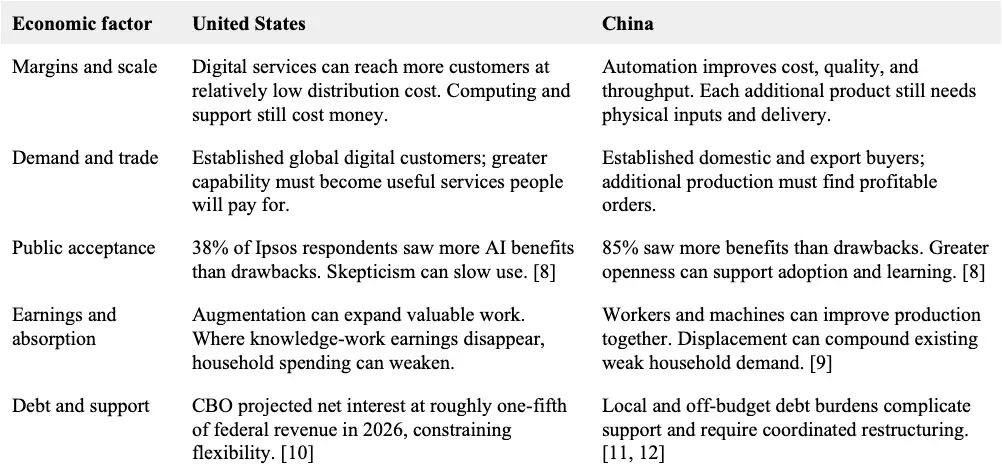
The table shows why the comparison cannot stop at margins or robot counts. High margins require paying customers. High production requires buyers. Acceptance helps useful tools spread, while people’s earnings help sustain demand. Debt influences the response when that income is interrupted.
Economic gain does not require reducing employment. Both paths can empower people to create more value. Job loss is a possible business choice and transition risk; it becomes an absorption problem when new earnings and support arrive too slowly.
Move forward to October 2029
Suppose both countries build successfully on their existing strengths. American digital suppliers bring more capable AI to global customers. Those customers use it to offer better services, solve harder problems, and expand useful work. Chinese manufacturers use dependable equipment and operating experience to improve quality, delivery, and production. Both can gain without following identical strategies.
Now suppose capacity grows faster than demand or household income. Digital suppliers struggle to turn use into paid revenue. Manufacturers compete for too few orders. Where employers cut staffing, lost earnings reduce spending and put pressure on other businesses. Debt makes supporting households harder just when help is needed.
These are conditional paths, not forecasts. By the third year, the meaningful evidence is whether useful capability became sustained value, whether customers bought the improved output, and whether people shared in the gains.
What emerged from the thought experiment
We began by asking what the U.S.–China AI race would produce. Looking at what each already supplies to the world revealed why the strategies differ. America’s established digital businesses create one route for AI to reach customers. China’s established manufacturing ecosystem creates another. Of course they pursue different emphases: their economic strengths and contributions differ.
That insight tells us how to ask better questions. The digital path has advantages in reach and margins. The physical path has advantages in production networks and learning from operating experience. Demand decides how much output can be sold. Employment income and public finances shape how people absorb the changes.
For construction, these forces influence the owners funding projects, the suppliers delivering materials and equipment, and the communities where we work. Looking only at our own AI tools misses much of the transition.CAL’s absorption research follows the connection between greater capability and people’s lives. By October 2029, the comparison should include the additional value produced, who received it, and whether households remained secure while work changed.
The United States and China are not running the same AI race. They are building on different economic strengths. Understanding those strengths lets us follow what each strategy creates—and what it takes for people to benefit.
— Sue
AI should serve humans. Humans should not serve the machine.
Sources and Evidence
1. International Trade Administration. SelectUSA Software and Information Technology Industry. U.S. software market leadership and established overseas market share. Read source
Microsoft. Microsoft celebrates 50 years. Historical timeline: founding in 1975; Office introduction in 1989. Read source
2. Amazon Web Services. Our Origins. S3 and EC2 launches in 2006. Read source
UNIDO. World Manufacturing Production and Trade Report, fourth quarter 2025. China as a major manufacturing production center. Read source
3. Microsoft. Microsoft Copilot for Work. Product capabilities demonstrate digital distribution, not economy-wide productivity outcomes. Read source
4. Amazon Web Services. Amazon Bedrock overview. Model access through existing cloud services. Read source
International Federation of Robotics. World Robotics 2026 release, September 24, 2026. Industrial robot installations are not a count of AI-learning robots. Read source
5. Ipsos AI Monitor 2026, p. 13 (PDF page 13). Survey conducted March 20–April 3, 2026. Online samples; country representativeness differs. Attitudes do not establish adoption or spending. Read source
6. IMF. How China’s Economy Can Pivot to Consumption-led Growth, February 18, 2026. Read source
Congressional Budget Office. The Budget and Economic Outlook: 2026 to 2036, February 2026. Figures are baseline projections, not current outturns. Read source
7. IMF. Local Government Finances in China: Policy Options to Tackle the Debt Overhang, September 24, 2026. Read source
8. IMF. China Article IV assessment, February 2026, augmented government debt projection. Broader coverage than U.S. federal debt held by the public. Read source
Research scope: The economic comparison and October 2029 paths are CAL analysis and thought experiments, not forecasts or a numerical index. Public-attitude figures measure surveyed views, not purchases. Fiscal figures are dated projections.
The Observers
Construction AI Labs Graphic Editorial

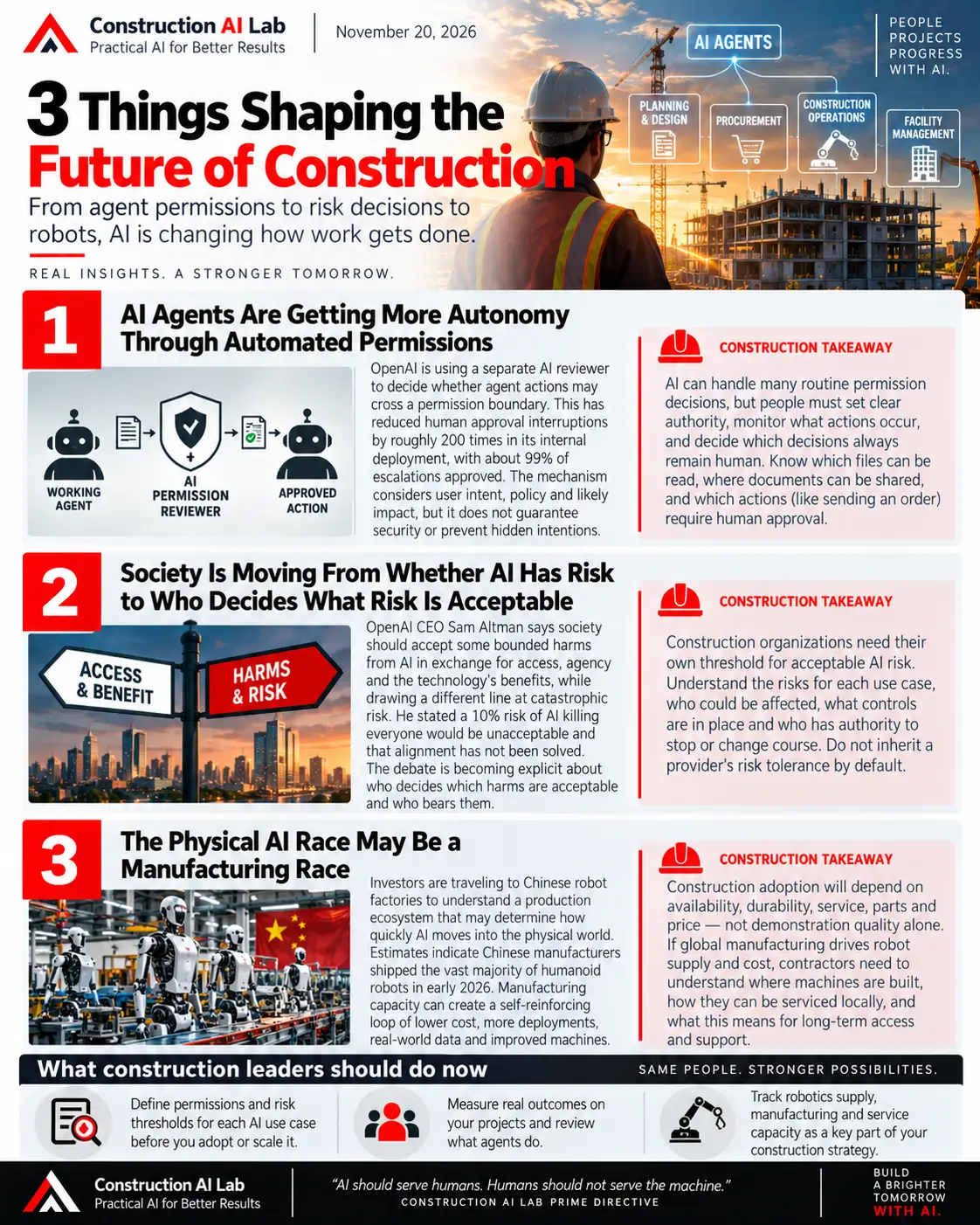
Three Things Shaping the Future of Construction
Monitoring AI so you don't have to.
What You Need to Know
Important AI developments that may affect construction.
1 AI Is Beginning to Manufacture Physical Devices from Code
Atomic Machines announced its Matter Compiler on October 7, describing an AI-native system for producing small machines from digital designs. Its first announced product is an electrical relay being evaluated by early customers. Production performance and economics have not been independently verified.
Construction relevance: Sensors, controls, and components used in buildings and equipment could eventually be designed and produced differently. Construction applications and reliability still need testing.
Evidence E084 | Open CAL evidence note
2 Adding More AI Agents Does Not Automatically Improve Results
BenchAgent compared single-agent and multi-agent workflows under matched benchmark conditions. Five of six multi-agent systems performed worse than the single-agent comparison. The study is a preprint, and the results do not establish how construction platforms perform.
Construction relevance: Judge agent systems by accurate, completed work—not the number of agents. Test whether drawing revisions, exclusions, and project requirements survive each handoff.
Evidence E086 | Open CAL evidence note
3 AI Is Beginning to Review Other AI Agents’ Permissions
OpenAI reports using a separate AI reviewer for certain agent actions outside a sandbox. Its internal results show substantially fewer interruptions for human approvals, but those figures do not measure safety or guarantee that unauthorized actions are prevented.
Construction relevance: Define which documents an agent may read, what information it may share, and which actions—such as issuing orders or changing records—still require human authorization.
Evidence E085 | Open CAL evidence note
4 The Race for Construction Robots Is Also a Manufacturing Race
Reporting on U.S. investors visiting Chinese robotics factories highlights the importance of components, production capacity, and supply chains. Different estimates place China at 77.9% or more than 97% of global humanoid shipments in the first half of 2026; the figures should not be treated as interchangeable.
Construction relevance: Field-ready robotics will depend on price, service, replacement parts, durability, and reliable deployment—not just impressive demonstrations.
Evidence E088 | Open CAL evidence note
5 AI Is Advancing the Mathematics Behind Engineering
DeepMind reported major progress on mathematical competition problems in 2024 and 2025. OpenAI published claimed mathematical research contributions in October 2026, with formal proofs for many results. These announcements do not demonstrate construction-ready engineering applications.
Construction relevance: Better mathematical methods may eventually improve structural optimization, water and airflow analysis, and construction planning. Engineers still must validate assumptions against physical conditions.
Evidence E093 | Open CAL evidence note
6 AI Conversations Can Feel More Confidential Than They Are
A reported Florida case involving a Claude conversation illustrates a gap between the experience of a private conversation and the rules governing provider review and disclosure. Anthropic describes access controls as well as safety-review and legal-process exceptions. The criminal allegations remain unresolved.
Construction relevance: Bid strategies, personnel matters, claims, and owner information should go only into approved AI environments with understood retention, access, and disclosure rules.
Evidence E095 | Open CAL evidence note
7 Companies Need to Protect the Knowledge They Build with AI
Microsoft describes adapting AI to an organization’s own workflow records; other suppliers are promoting greater model customization and control. These are vendor announcements, not proof that company-specific AI learning can be exported or transferred between providers.
Construction relevance: Preserve more than original project files. Establish rights to retain, inspect, correct, and move the estimating judgment, field lessons, and workflows your teams help AI develop.
Evidence E094 | Open CAL evidence note
Help Shape What We Study
What are you seeing in your company, project, or part of the industry? What questions about AI do you think construction needs to understand? Questions and observations from the industry help inform the Lab’s ongoing research.
Email: [email protected] | Subject line: Dear Sue
ABOUT THE AUTHOR
Sue Dyer is a construction industry leader, Wall Street Journal bestselling author of The Trusted Leader, and a pioneer of Partnering. Through Construction AI Lab, she helps construction leaders make sense of AI—what’s working, what’s not, and what is most important. Contact [email protected]
This publication is provided for educational and informational purposes only and does not constitute legal, cybersecurity, technical, or professional advice. Organizations should evaluate their own operational, legal, security, and governance requirements when implementing AI technologies. AI systems, policies, and industry practices continue to evolve rapidly. Construction AI Lab and sudyco® make no guarantees regarding specific outcomes, compliance, or risk mitigation associated with the use of AI technologies.
© 2026 Construction AI Lab, an initiative of sudyco®
Built for the Industry. Meant to be Shared. You Have Our Permission.