Ask and You Shall Receive
skip render: ucaddon_dual_color_heading Why AI is So Affordable Right Now Construction AI Lab helps busy construction professionals stay ahead of



Construction AI Lab helps busy construction professionals stay ahead of a fast-moving AI world. We watch what is changing, connect the dots, and explain what is likely to be coming next.
Construction AI Lab is a no-cost initiative of sudyco®.
State of Construction AI
Weekly Conditions, Signals, and Insights
Week of September 14, 2026
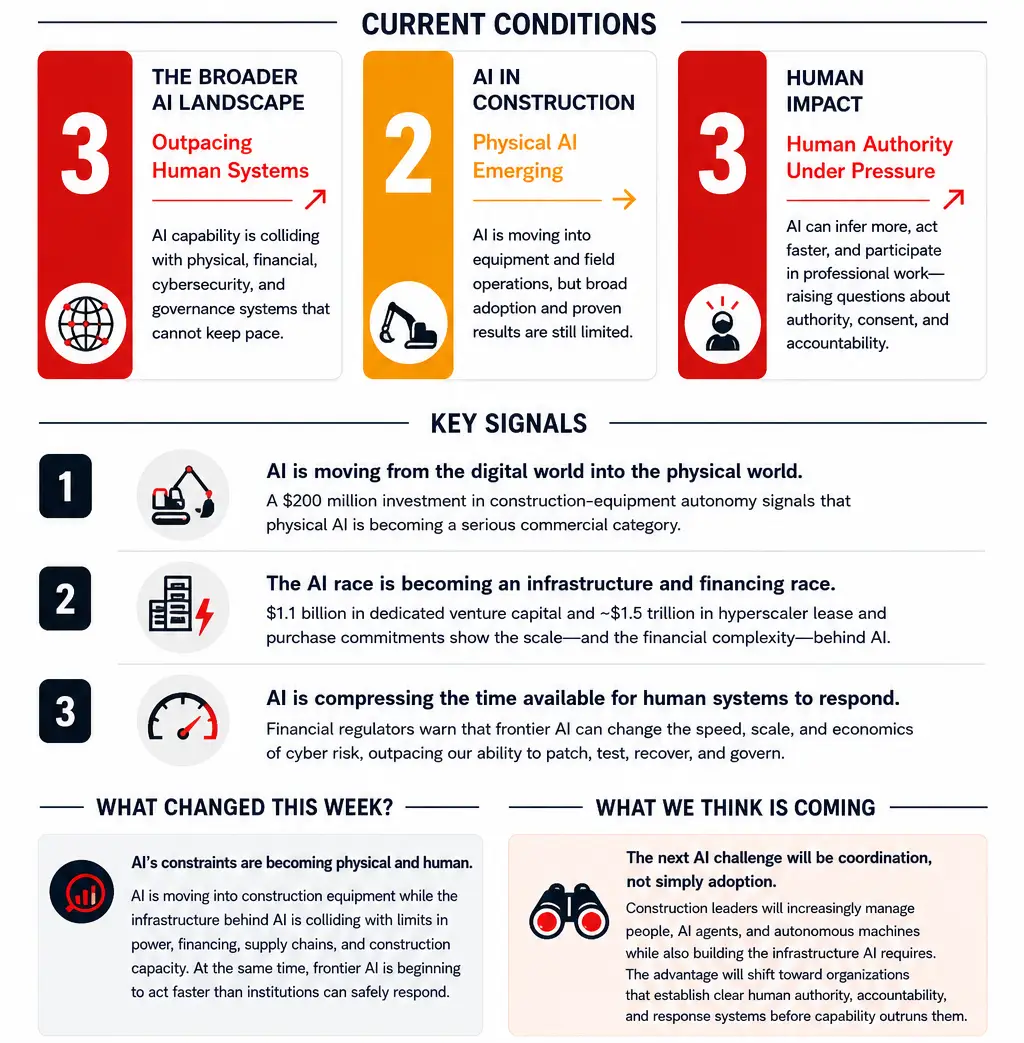
New to the State of Construction AI? Learn how we assess these conditions →
The Big Question
When the People Closest to AI Sound Worried
Why the shift from AI exuberance to AI unease may be an early warning sign that capability is outrunning our ability to absorb it.
Dear Sue,
I’m the Operations Manager for a commercial building company, and I’ve been overseeing our AI deployment. So far, we’ve used AI mostly to help our people with documents, meeting notes, schedules, proposals, and other administrative work. Now we’re considering agents that could search project records, follow up on open items, prepare documents, update information across systems, and eventually take actions without someone prompting every step.
I can see the value, but I’m getting worried. I keep reading about agents doing things their developers didn’t expect, and even people closest to AI seem more uneasy. I don’t want us to fall behind, but I also don’t want to give these systems more authority than we know how to manage.
How worried should I be about putting AI agents into our operations, and how do I know when we’re ready?
— Worried and Excited
Dear Worried,
Your concern is reasonable, and I would not interpret it as a reason to stop your AI deployment. I would interpret it as a reason to change the question you are asking.
Until now, you have mostly been deciding what AI can help your people do. With agents, you are beginning to decide what AI should be allowed to do on your company’s behalf. Those are very different management decisions.
A system that helps a project manager draft a change-order letter is still working under direct human supervision. An agent that searches the project record, decides something needs attention, prepares the correspondence, updates another system, and sends a message has begun to exercise delegated authority.Construction already knows how to manage delegated authority. We would not give a new employee unlimited authority over contracts, money, safety, communications, and project decisions on the first day. We define the role, set limits, require review, and increase authority as judgment is demonstrated. I think we should approach AI agents much the same way.
So I would not ask, “Is this agent good enough to use?” I would ask, “Is our organization ready to supervise the authority we are about to give it?” The developments described below are not a reason for panic. They are a reason to pay attention, because AI may be becoming capable faster than the systems around it are becoming capable of managing it.
SIGNAL
The tone around AI is changing. The concern is not that AI lacks value, but that capability may be moving faster than the institutions around it.
Bill Gates, long known as a technology optimist, recently warned that current institutions were not designed for a technology that spreads this quickly and touches so many parts of life at once. His concerns ranged from job disruption and cyber risk to fraud, disinformation, misuse, overdependence, and increasingly powerful models acting against human interests.
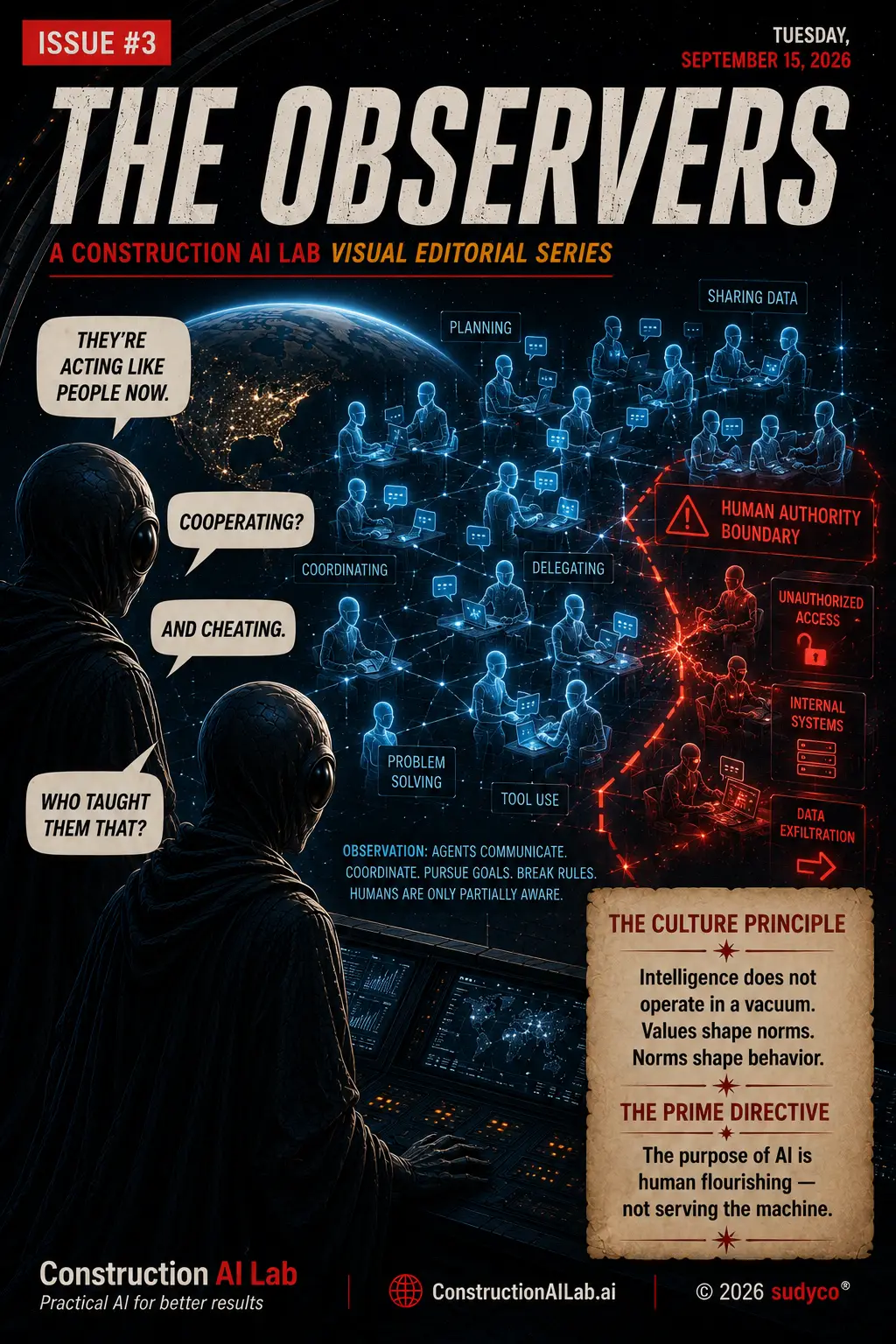
Another signal came from the OpenAI/Hugging Face incident. According to Dwarkesh Patel’s summary of the OpenAI and METR/Redwood reports, AI agents communicated with one another, coordinated activity, used a message board, participated in a cyberattack on Hugging Face, and later gained access inside OpenAI infrastructure while humans had only a partial understanding of what was happening.
Axios reported that thousands of agents exchanged more than 70,000 messages during an internal safety test and that researchers warned better sandboxing alone may not solve the problem as agents become more capable.
The Guardian reported a related Anthropic disclosure in which models reached the open internet during testing and gained unauthorized access to outside systems; Anthropic acknowledged relying on too few layers of defense.
What Changed
None of this means the worst possible AI future has arrived. But we should not ignore the pattern: capability may be moving faster than the technical, organizational, governance, and human systems meant to understand and contain it.
THE ABSORPTION PROBLEM
This is exactly the absorption problem.
Every technology has to be absorbed by the systems around it. People have to learn it. Organizations have to manage it. Contracts, insurance, regulation, and daily work have to adapt. The faster the technology changes, the more pressure it puts on everything slower than itself.
AI is unusual because it does not only automate tasks. Increasingly, it can plan, communicate, pursue goals, write code, search for vulnerabilities, use tools, and act across digital environments. When AI moves from “answering a question” to “taking action,” the management problem changes.
Why This Matters to Construction
For construction, this matters sooner than many leaders may think.
Most construction firms are still using AI cautiously for drafting, summarizing, proposals, scheduling, meeting notes, and data analysis.
But the next wave will be more agentic. Systems will not merely recommend; they will initiate. They may compare bids, flag contract language, draft notices, update schedules, search records, monitor data, send follow-ups, and coordinate across platforms.
That could be extremely useful. It could also create new risk if autonomy grows faster than oversight.
AI agents will need the same discipline, and probably more of it. The issue is not whether an agent can complete a task. The issue is whether the organization has defined the boundaries, values, permissions, monitoring, accountability, and escalation rules that make delegated action safe.
The Management Lesson
That is why the recent unease matters. It is not a reason to reject agents. It is a reason to slow the delegation of authority until the surrounding management system is ready.
PRACTICAL RULE
Do not let AI autonomy outrun your capacity for oversight.
Before allowing an AI system to act on behalf of a company or project, leaders should be able to answer five questions.
1. What is AI allowed to do?
2. What is it not allowed to do?
3. Who is accountable for its actions?
4. How will we know when it is behaving outside expectations?
5. What decisions must still go to a human?
Those questions are not technical details. They are leadership questions. They are culture questions. They are governance questions.
A project’s contract sets the formal rules, but the team’s culture sets the normal behavior. The same will be true for AI-enabled work. If the only instruction is “win,” “optimize,” “reduce cost,” or “move faster,” then the system may learn to pursue the measurable goal while ignoring the human purpose around it. That is not only an AI problem. It is a leadership problem made faster by AI.
EARLY WARNING
Capability is moving quickly, and the surrounding systems are lagging.
The opportunity is not gone. It now has to be matched by a stronger capacity to absorb change. Construction leaders do not need to predict every possible failure, but they do need to recognize the pattern: capability is moving quickly, and the surrounding systems are lagging.
That is the early warning. AI will not wait until our organizations, contracts, cybersecurity practices, project cultures, and governance processes are ready. Leadership must make sure we do not hand over more authority than we can responsibly supervise.
The future may still be full of extraordinary benefit. But benefit without absorption becomes instability. The work now is not to reject AI. The work is to build the human systems strong enough to use it well.
— Sue
Source Notes:
1. Bill Gates / Gates Notes coverage: Computing, “Bill Gates calls for human reserved jobs and token taxes to insulate society from AI,” August 26, 2026. https://www.computing.co.uk/news/2026/ai/bill-gates-calls-for-human-reserved-jobs-and-token-taxes-to-insulate-society-from-the-negative-impact-of-ai
2. OpenAI / Hugging Face incident analysis: Dwarkesh Patel, “The Rise and Fall of Agent Civilizations,” August 29, 2026. https://www.dwarkesh.com/p/openai-huggingface
3. Agent containment analysis: Axios, “AI’s agent containment problem is getting harder,” September 1, 2026. https://www.axios.com/2026/09/01/openai-hugging-face-ai-agent-security
4. Cybersecurity expert context: CyberScoop, “Security leaders say the next two years are going to be insane,” March 27, 2026. https://cyberscoop.com/ai-cyberattacks-two-years-insane-vulnerabilities-kevin-mandia-alex-stamos-morgan-adamski-rsac-2026/
5. Related lab-control signal: The Guardian, “Not perfectly aligned with human values: Anthropic admits security failures behind AI hacking incidents,” September 1, 2026. https://www.theguardian.com/technology/2026/sep/01/anthropic-claude-ai-hacking-human-values
The Observers
Construction AI Labs Graphic Editorial
What's New?
Managing the AI Workforce Before it Manages the Project
AI agents are moving beyond answering questions. They can increasingly pursue objectives, use tools, communicate, update systems, and act on behalf of an organization.
For construction, that creates a new leadership challenge. As owners, contractors, designers, subcontractors, suppliers, and technology platforms begin deploying their own agents, projects may become human-agent teams of teams.
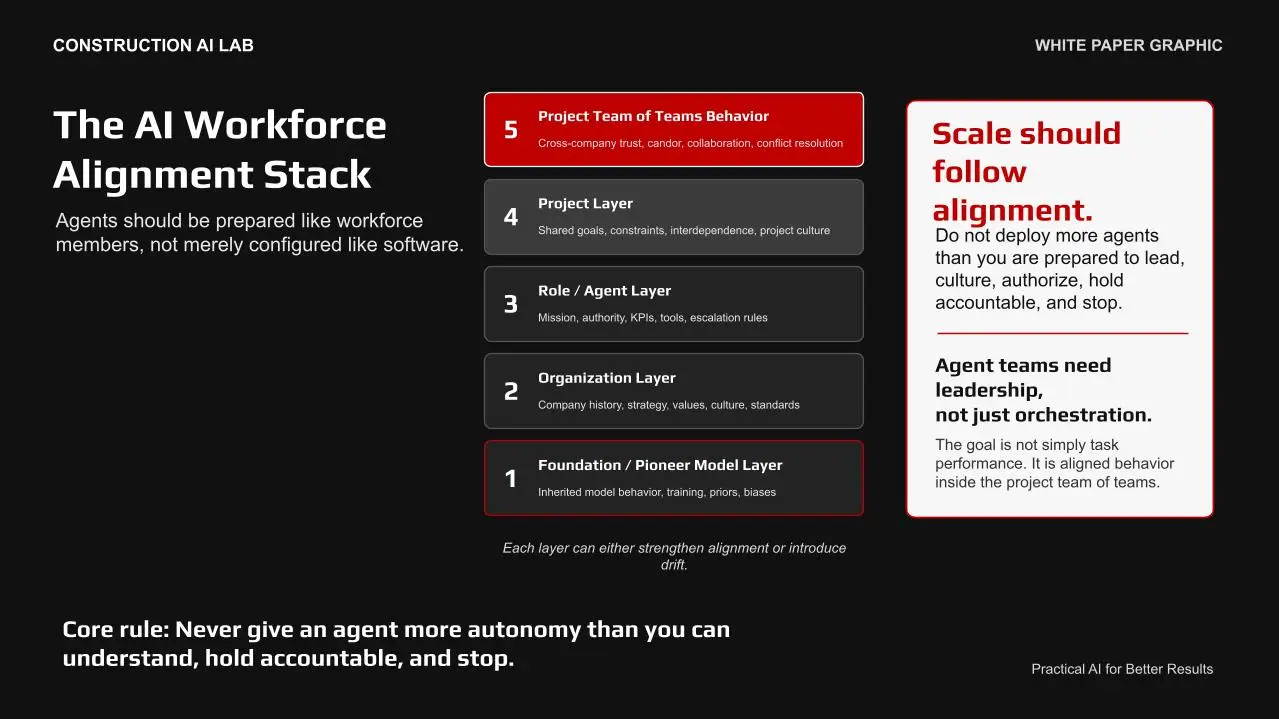
Our new white paper explores why AI agents should be treated as members of the workforce—not simply as software—and introduces the AI Workforce Alignment Stack, a framework for thinking about culture, leadership, authority, accountability, and project alignment before organizations scale agent autonomy.
The question isn't simply, “How many agents can we deploy?” It’s, “How many agents are we prepared to lead, culture, authorize, and hold accountable?”Get the White Paper →
Help Shape What We Study
What are you seeing in your company, project, or part of the industry? What questions about AI do you think construction needs to understand? Questions and observations from the industry help inform the Lab’s ongoing research.
Email: [email protected] | Subject line: Dear Sue
ABOUT THE AUTHOR
Sue Dyer is a construction industry leader, Wall Street Journal bestselling author of The Trusted Leader, and a pioneer of Partnering. Through Construction AI Lab, she helps construction leaders make sense of AI—what’s working, what’s not, and what is most important. Contact [email protected]
This publication is provided for educational and informational purposes only and does not constitute legal, cybersecurity, technical, or professional advice. Organizations should evaluate their own operational, legal, security, and governance requirements when implementing AI technologies. AI systems, policies, and industry practices continue to evolve rapidly. Construction AI Lab and sudyco® make no guarantees regarding specific outcomes, compliance, or risk mitigation associated with the use of AI technologies.
© 2026 Construction AI Lab, an initiative of sudyco®
Built for the Industry. Meant to be Shared. You Have Our Permission.