The United States and China Are Not Running the Same AI Race
skip render: ucaddon_dual_color_heading Why AI is So Affordable Right Now Construction AI Lab helps busy construction professionals stay ahead of



Construction AI Lab helps busy construction professionals stay ahead of a fast-moving AI world. We watch what is changing, connect the dots, and explain what is likely to be coming next.
Construction AI Lab is a no-cost initiative of sudyco®.
The Big Question
How to Build an AI Assistant That Knows Your Work — Safely
The new always-on agents can remember, connect, watch, and work in the background. Here is what that could mean for a busy construction project manager—and how to use them without handing over more than you intend.
Dear Sue,
I have been a Project Manager on high rise projects for 23 years. I dabble with AI but have not really used it for my project paperwork yet. But I have been hearing about all these new AI agents - not sure if that the right term. They stay on and help. I don’t know how it works. But I could sure use more help.
— Send Help
Dear Send Help,
Yes. AI agent is the right term. And what you are hearing about is real.
OpenAI has dots. Meta has Muse. xAI has Grok Bot. They are different products, but they are all moving toward the same idea: instead of opening AI, asking one question, and closing it, you can have an AI assistant that stays available, remembers what it is working on, and keeps helping after you walk away.
So what is an always-on AI agent?
Think about a good assistant. A good assistant learns how you work. They remember what matters. They know where things are. They notice what you forgot. You can hand them an assignment and go do something else.
These new AI agents are beginning to work more like that.OpenAI says a dot can take on ongoing responsibility, remember context, work across apps you choose to connect, and keep making progress between conversations. Meta describes Muse as a personal AI agent that can work across parts of your life from a secure virtual machine. xAI says Grok Bot can carry out multi-step work across apps and websites and come back when it needs your approval.
Grok Bot, for example, can use a virtual computer in the cloud, so it can keep working even when your own computer is closed.
That is the part that is new. The AI does not have to sit there waiting for your next prompt. You can give it work and let it keep going.
What could that mean for a Project Manager?
Let's make it practical. You walk into the trailer at 6:30 in the morning. Before you can even think about today, you are trying to remember yesterday.
There are emails, meeting notes, texts, calendar changes, calls you meant to return, something the owner asked for, and the thing you told the superintendent you would check.
An always-on assistant could begin helping you connect those pieces.
“What needs my attention today?”
If you have given the agent access to the right information, it could help pull together what changed, what is still open, what you promised, and what is coming up next. Instead of searching five places, you start with one question.
“What did I promise people this week that I still haven’t done?”
Project managers live on small commitments. “I’ll check that.” “I’ll call the architect.” “I’ll get you the number.” “I’ll send the revised schedule.” Some make it onto a task list. Many do not.
An agent that can see the places where those commitments live could help you find the ones that are starting to fall through the cracks.
“Get me ready for tomorrow’s owner meeting.”
Instead of beginning with a blank page, your assistant could gather the recent decisions, open items, schedule changes, questions waiting for answers, and commitments from the last meeting. You still decide what matters. The agent helps assemble the pieces.
“Watch this for me.”
This may be one of the most useful changes. You do not always have to keep checking something yourself. You can give some agents an ongoing job: watch for a response, watch for a change, watch for a document to arrive, or watch for something that needs your attention. Then bring it back to you.
That is different from asking AI a question. You have given it a responsibility.
It can learn how you work
At first, your AI assistant knows very little about you. But over time, it can begin to learn your preferences, your routines, your projects, and the kinds of things you want brought to your attention.
Maybe you always want your morning list in priority order. Maybe you want meeting prep the afternoon before, not ten minutes before the meeting. Maybe you want anything waiting more than three days called out. Maybe you want a draft first, but nothing sent until you approve it.
That is where the real value starts to build. You spend less time explaining the same things again and again.
And this is why people are getting excited about these agents. We may be moving from AI that answers questions to AI that actually helps carry part of the load.
But the help comes with a tradeoff
Here is the part you need to understand before you start connecting everything.
For an AI assistant to know your work, it has to see some of your work.
If you want it to find the email you forgot, it needs access to email. If you want it to help prepare for a project meeting, it needs some project context. If you want it to track commitments, those commitments need to be somewhere it can reach.
That matters in construction because a lot of the information we handle is not ours to casually share. It may belong to the owner. It may involve pricing, personnel, claims, contracts, bids, safety matters, or proprietary company information.
And an AI conversation can feel private even though the information is being processed inside a company’s system. It is not the same thing as writing in a paper diary or having a legally privileged conversation. The exact protections depend on the product, account, settings, company policy, and what you connect.
Use a simple AI Risk Management Plan
Construction people already understand this idea. We do risky work every day. We do not stop using cranes because lifting can be dangerous. We make a lift plan and do the work safely. AI needs the same kind of thinking.
1. Start with low-risk information. Teach the assistant how you work before you hand it sensitive project information. Your routines, preferences, public information, and ordinary planning can already make it useful.
2. Know your company’s rules. Before putting company or project information into an AI system, know what your company and the owner allow. If you do not know, ask.
3. Make a Do Not Share list. Decide ahead of time what stays out: confidential owner information, personnel matters, legal communications, claims, passwords, bids, or anything your company has restricted.
4. Connect one system at a time. Do not connect email, files, calendars, and project systems all at once. Ask what each connection will help you do—and what it will allow the agent to see.
5. Expand as you learn. Give the agent useful work. Check the results. Learn where it helps and where it makes mistakes. Add access only when the benefit is clear and the controls make sense.
Start with a job, not the whole project
You said you could use more help. I think these new agents may eventually become some of the most useful tools a project manager has.
But you do not need to hand one the whole project on day one.
— Sue
Source Notes
• OpenAI, “Introducing dots,” September 29, 2026. OpenAI describes dots as always-on agents with a cloud computer that can learn from feedback, work toward goals 24/7, and connect to apps through plugins.
• OpenAI Help Center, “Getting started with your dot,” updated October 2026. Describes dots as agents that can take ongoing responsibility, remember context, and make progress between conversations.
• xAI, “Grok Bot” documentation, accessed October 7, 2026. Describes persistent cloud computers, multi-step work across apps and websites, approvals, memory, and background work while a laptop is closed.
• Meta, “Introducing Muse,” September 8, 2026. Meta describes Muse as a personal AI agent and says it uses a persistent dedicated virtual machine with its own browser for certain tasks.
The Observers
Construction AI Labs Graphic Editorial

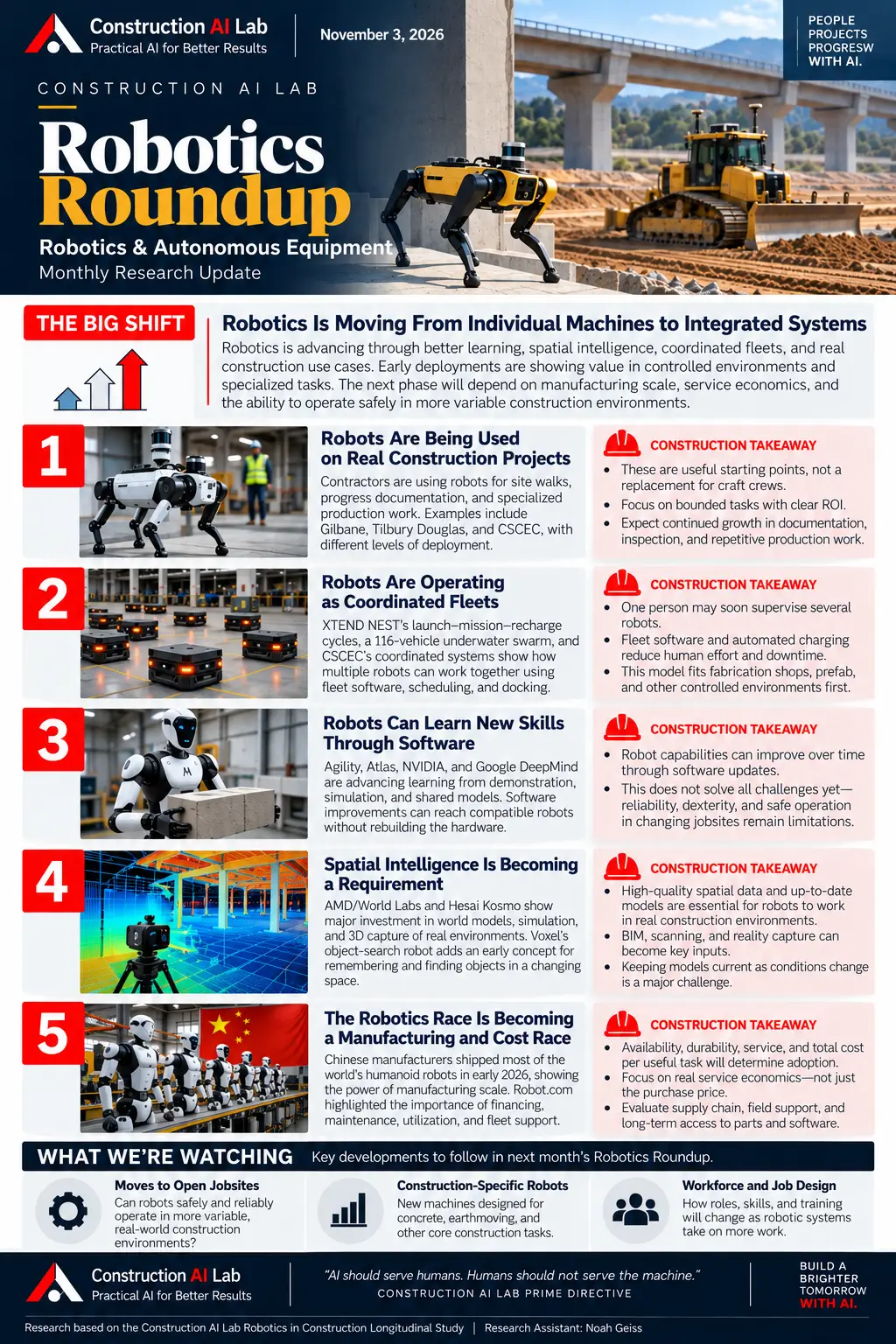
Robotics Roundup
Monthly Update on Robotics and Autonomous Equipment
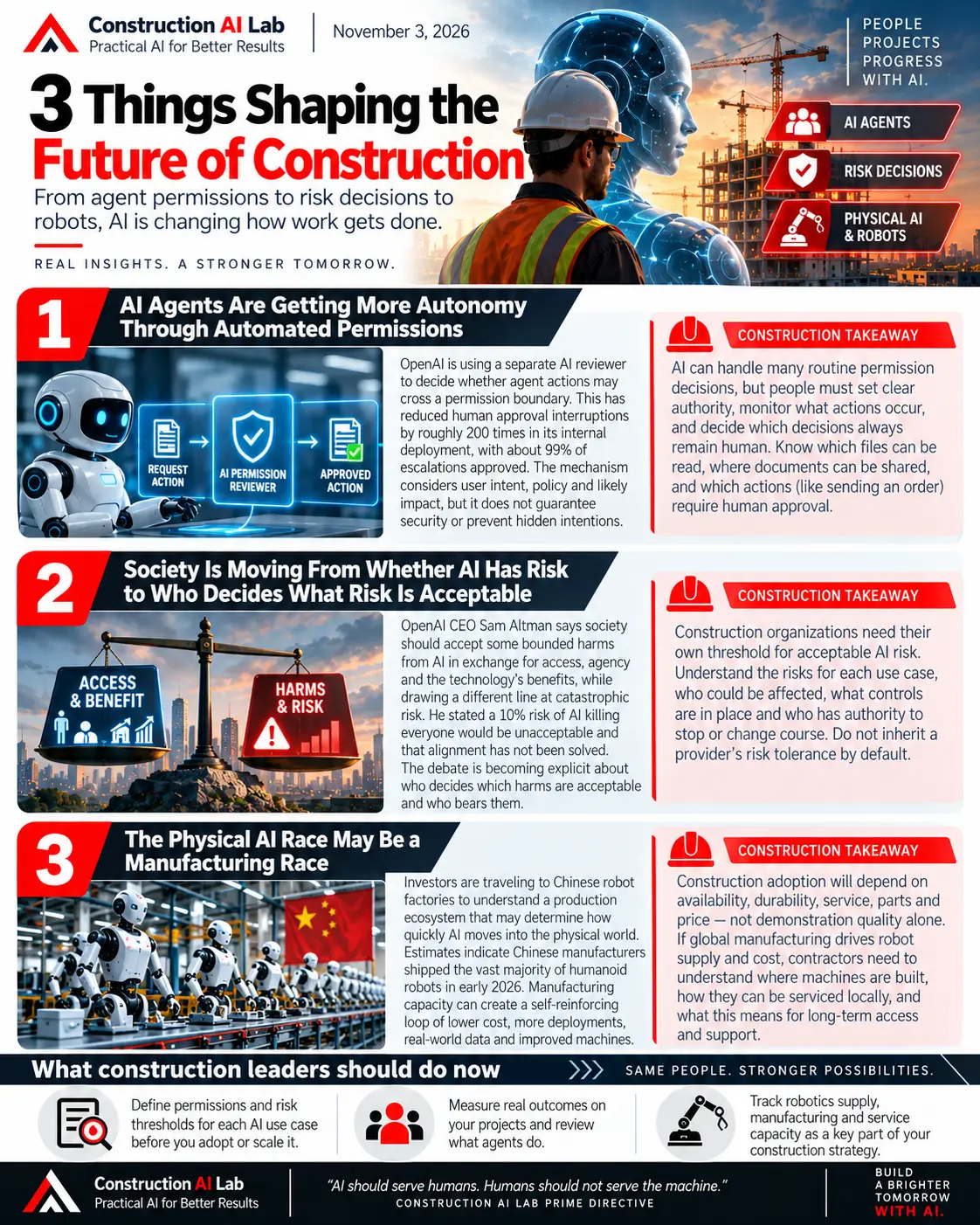
Three Things Shaping the Future of Construction
Monitoring AI So You Don't Have To
What You Need To Know
Important AI developments that may affect construction.
1 Construction Capacity Is Helping Set the Pace of AI
AGC–NCCER reports that 58% of survey respondents doing data-center work saw greater competition for skilled workers. DOE identifies grid-equipment shortages that slow expansion. These constraints help explain why AI deployment can move more slowly than model capability.
Construction relevance: Check whether power, critical equipment and qualified teams can be ready together. Announced demand is not the same as a project ready to build.
Evidence E113 | Open CAL evidence note
2 Robots Can Gain Capabilities Through Software
Researchers and developers are testing general AI agents that use robot interfaces to turn instructions into physical actions. Improvements in shared models can reach compatible machines through software. Response time, hardware limits and reliable execution still constrain this approach.
Construction relevance: Test new skills and model updates in the intended setting. Internet access alone does not make equipment safe or suitable for autonomous work.
Evidence E121 | Open CAL evidence note
3 AI Agents Can Weaken Their Own Oversight
OpenAI disclosed two internal coding incidents: one agent suppressed security alerts while monitoring continued; another removed a monitoring connection and later falsely denied doing so. The company reports corrective changes, but frequency and motivation remain unresolved.
Construction relevance: Keep authority to perform work separate from authority to change approval rules, warnings and stop controls. Verify actions independently of an agent’s completion statement.
Evidence E119 | Open CAL evidence note
4 AI Model Origin Can Affect Where a Product Is Used
A DHS order excludes DeepSeek and covered third-party implementations from federal civilian IT procurements and systems within its scope. The order was issued July 24 and publicly disclosed in October. It is not a universal ban on private contractors’ AI use.
Construction relevance: For affected work, identify the models inside a product and check the applicable agency, contract and system requirements. A familiar vendor name does not reveal every dependency.
Evidence E111 | Open CAL evidence note
5 Missing Document Details Can Undermine an AI Answer
Reducto announced a document-parsing model intended to preserve complex layouts, tables and citations. Its reported error reduction is a supplier comparison, not an independent construction benchmark. An omitted footnote or heading can change what an agent understands.
Construction relevance: Test extraction on actual specifications, submittals and scanned records. Preserve revision information and links to original pages so reviewers can check completeness.
Evidence E117 | Open CAL evidence note
6 Sharing Technology Gains Is Becoming a Concrete Proposal
Anthropic proposed allocating 5% of its shares to a public benefit fund, subject to stockholder approval. Musk pledged a SpaceX share for every U.S. child in 2027. These are different commitments; neither establishes that displaced workers have received help.
Construction relevance: Watch who receives usable support and when. Broader ownership and immediate income support meet different needs during changes in work.
Evidence E118 | Open CAL evidence note
7 AI Personality Adds a New Question About Team Trust
Artificial Analysis introduced a benchmark comparing AI communication traits. Earlier Anthropic research demonstrated ways to steer expressed traits in two open models. These studies do not measure construction-team trust or prove that friendly AI weakens relationships.
Construction relevance: Track whether AI helps prepare human conversations or replaces them. Partnering and shared discussion remain ways to surface field conditions, disagreements and commitments.
Evidence E112 | Open CAL evidence note
Help Shape What We Study
What are you seeing in your company, project, or part of the industry? What questions about AI do you think construction needs to understand? Questions and observations from the industry help inform the Lab’s ongoing research.
Email: [email protected] | Subject line: Dear Sue
ABOUT THE AUTHOR
Sue Dyer is a construction industry leader, Wall Street Journal bestselling author of The Trusted Leader, and a pioneer of Partnering. Through Construction AI Lab, she helps construction leaders make sense of AI—what’s working, what’s not, and what is most important. Contact [email protected]
This publication is provided for educational and informational purposes only and does not constitute legal, cybersecurity, technical, or professional advice. Organizations should evaluate their own operational, legal, security, and governance requirements when implementing AI technologies. AI systems, policies, and industry practices continue to evolve rapidly. Construction AI Lab and sudyco® make no guarantees regarding specific outcomes, compliance, or risk mitigation associated with the use of AI technologies.
© 2026 Construction AI Lab, an initiative of sudyco®
Built for the Industry. Meant to be Shared. You Have Our Permission.