Ask and You Shall Receive
skip render: ucaddon_dual_color_heading Why AI is So Affordable Right Now Construction AI Lab helps busy construction professionals stay ahead of



Construction AI Lab is a no cost sudyco® initiative focused on understanding how AI is actually showing up across the construction industry—what’s being used, what’s working, what’s not, and what’s coming next.
What Human Skills Become More Valuable if AI Eliminates 50% of Design Work?
Dear Sue,
In one of your newsletters, you talked about how AI is starting to be used in estimating. I am an Architect and I am concerned about how AI is going to affect architecture.
— Concerned
Dear Concerned,
The Easy Part to Automate
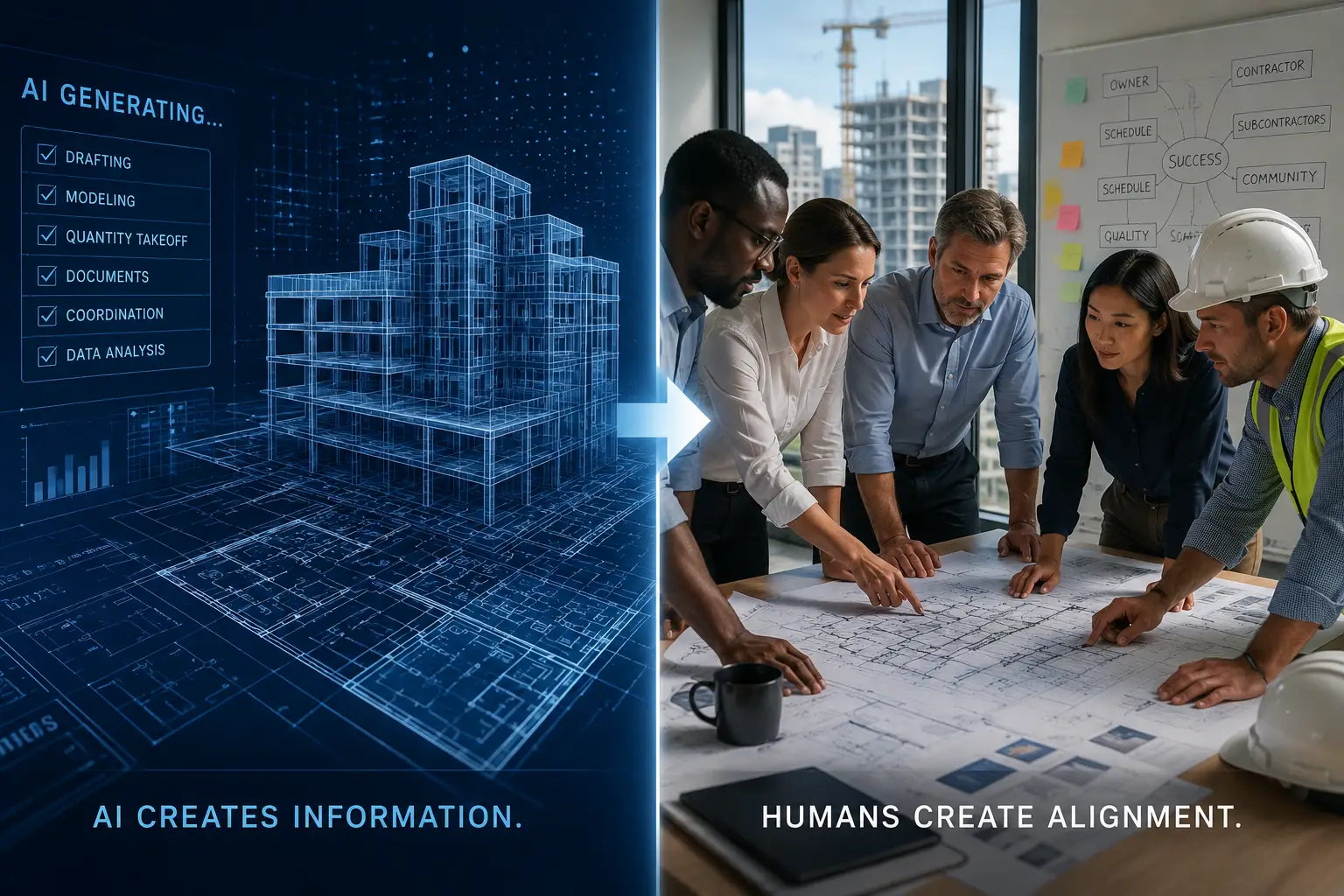
Artificial intelligence is rapidly improving at activities such as drafting, modeling, document production, specification generation, quantity extraction, coordination support, and data analysis. Many of these tasks consume significant time and labor today, and it is reasonable to expect AI to increase productivity in these areas substantially over the next decade.
If a design firm can produce the same output with 40 people instead of 100, or 20 people instead of 100, the impact on the industry would be profound. But that raises a critical question: what remains after the production work becomes highly automated?
The Remaining Work is Human Work
Construction projects are not simply collections of drawings and specifications. They are temporary organizations made up of owners, designers, contractors, subcontractors, utilities, regulators, inspectors, and community stakeholders. Every project requires hundreds or thousands of decisions, and every project involves priorities and risks that are distributed unevenly across the team.
Someone must still align stakeholders, resolve conflicts, build trust, negotiate tradeoffs, make decisions under uncertainty, coordinate across organizations, and manage accountability. These are not technical challenges. They are human challenges. And AI does not eliminate them.
A Hidden Assumption
Many discussions about AI assume the future will require fewer people. That may be true. But it does not necessarily mean people become less important. In fact, the opposite may occur.
As technical production becomes easier, the remaining work becomes increasingly dependent on human judgment and human collaboration. The value shifts from producing information to acting on information. The value shifts from generating drawings to aligning people. The value shifts from documentation to decision-making.
What Our Project Data Suggests
For years, our team has tracked project momentum through a structured partnering scorecard that measures factors such as trust, teamwork, accountability, commitment follow-through, issue resolution, and progress toward project goals.
One of the most consistent observations is that project outcomes are often visible long before schedule reports, cost reports, or claims reveal them. Projects with strong positive momentum tend to perform better. Projects with strongly negative momentum often become trapped in blame, distrust, poor communication, and delayed issue resolution. In many cases, we can see the trajectory of a project months before traditional project controls identify a problem.
Why? Because projects are built by people. And people determine how quickly information flows, how effectively issues are resolved, and how well decisions are made.
The Future May Require More Collaboration, Not Less
Suppose AI dramatically increases productivity. Teams become smaller. Organizations become leaner. Decisions happen faster. There is less redundancy and less organizational slack.
In that environment, trust failures become more expensive. Misalignment becomes more expensive. Poor communication becomes more expensive. A highly efficient team that falls into blame and distrust can unravel very quickly. The need for effective collaboration does not disappear. It becomes more important.

Construction is Organized Around Risk
"Your AI only knows what people are willing to tell it."
The Real Question
Final Thought
The future of construction is unlikely to be Human vs. AI. It is far more likely to be Human plus AI. And that makes the quality of human interaction more important than ever.
Did this help you? Have a question? Or willing to share how you're using AI in the field? Let us know — and your question or story may be featured in a future issue of Construction AI Lab. Email: [email protected] | Subject line: Dear Sue
ABOUT THE AUTHOR
Sue Dyer is the founder of Construction AI Lab, where she shares simple, practical ways construction professionals can use AI to save time, reduce frustration, and run better projects. Contact: [email protected]
This publication is provided for educational and informational purposes only and does not constitute legal, cybersecurity, technical, or professional advice. Organizations should evaluate their own operational, legal, security, and governance requirements when implementing AI technologies. AI systems, policies, and industry practices continue to evolve rapidly. Construction AI Lab and sudyco® make no guarantees regarding specific outcomes, compliance, or risk mitigation associated with the use of AI technologies.
© 2026 Construction AI Lab, an initiative of sudyco®
Built for the Industry. Meant to be Shared. You Have Our Permission.