Ask and You Shall Receive
skip render: ucaddon_dual_color_heading Why AI is So Affordable Right Now Construction AI Lab helps busy construction professionals stay ahead of



Construction AI Lab is a sudyco® initiative focused on understanding how AI is actually showing up across the construction industry—what’s being used, what’s working, what’s not, and what’s coming next.
Construction AI Reality Check - May 2026
What’s Actually Happening with AI in Construction Right Now
Dear Sue,
I have been hearing a lot about AI in construction lately, but I am wondering if anyone is really using it - and if so, where and how? What results are they getting?
— AI Curious
AI Curious, That’s the Right Question
You are correct, anyone paying attention to the construction industry lately, has been hearing a lot about AI. You might think it is transforming every jobsite, every back office, and every project overnight. You might feel like you are getting left behind.
But when you step away from the conferences and the press releases and look at what’s actually happening on projects—real projects, run by real people under real schedule and budget pressure—the picture looks very different. It’s not a sweeping transformation. It’s not coordinated. It’s not even close to fully adopted.
What’s actually happening is smaller than the headlines suggest. It’s practical. And it’s spreading one person at a time, through individual problem-solving rather than company-wide rollouts. That might sound underwhelming—but it’s actually how durable change tends to happen in the industry.
What We’re Actually Seeing in the Field
Across the industry, AI adoption in construction isn’t showing up as a top-down initiative (of course there are a few exceptions). For the most part, no one is standing in front of an all-hands meeting saying, “As of Monday, we’re an AI company.” There aren’t large teams getting certified, and most projects are not formally designated as “AI-enabled” in any meaningful sense. What’s happening instead is more organic—and in many ways, more interesting.
AI is showing up in very specific moments, triggered by very specific pain points. A project engineer is under the gun on a deadline and doesn’t want to draft an RFI from scratch, so they run a quick prompt and get a solid starting point in two minutes instead of twenty. An estimator has a thick set of specs and not enough time, so they feed a section into an AI tool to check for gaps before submitting the bid. A project manager wraps up a long, complicated meeting, drops in their rough notes, and uses AI to organize what actually needs follow-up versus what was just conversation.
None of that is formal. None of it shows up in a company’s digital transformation strategy. But it’s real, it saves time immediately, and that’s exactly why it’s spreading. When something solves a problem you had today, you use it again tomorrow.
The Construction AI Heat Map: May 2026
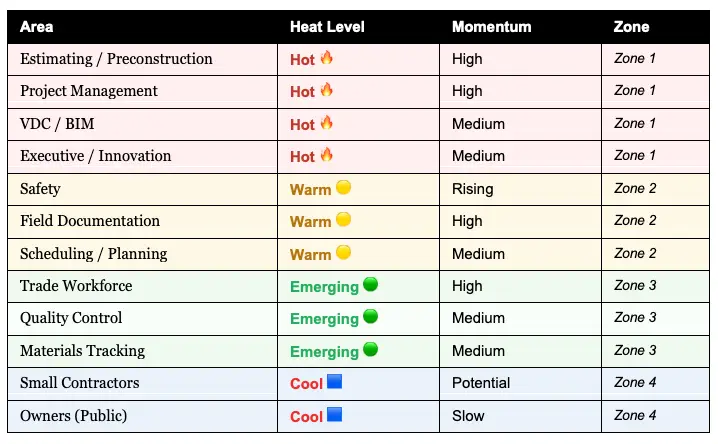
To make sense of where adoption is actually concentrated, we did some research and mapped the construction industry across twelve functional areas. Each area was assessed for two things: how much AI activity we’re seeing right now (“Heat Level”) and how quickly that activity appears to be growing (“Momentum”). Here’s what the map looks like as of May 2026.
Zone 1: Where AI Is Already Working
Estimating and Preconstruction
If you had to pick one part of construction where AI is delivering real, repeatable value right now, estimating is probably it. Estimators have always faced a specific kind of pressure—reading through enormous volumes of documents, comparing scope across multiple trades, hunting for gaps in coverage, and doing all of this under deadlines that don’t move. It’s exactly the kind of work where the cost of missing something is enormous and the volume of information to process keeps growing.
AI doesn’t replace the estimator’s judgment. But it dramatically accelerates the front-end processing work. Teams are using AI to review scope documents, flag potential risks, and organize project information so that the humans doing the actual estimating can get to the analysis faster and with less likelihood of missing something obvious. The tool handles the volume; the estimator makes the call.
This is an area where both momentum and heat are high—which means adoption is not only widespread but accelerating. If you’re in preconstruction and you’re not experimenting with AI-assisted document review yet, you’re behind the curve.
Project Management
Project managers and project engineers are finding AI useful in many of the same ways—high volume, high repetition, high consequence if something falls through the cracks. RFIs are a perfect example. A well-crafted RFI takes time to write, but it follows a structure. AI handles the structure; the PM handles the judgment about what actually needs to be asked and why.
Meeting documentation is another high-value use case. Construction projects generate a staggering amount of meeting content—OAC meetings, subcontractor coordination, owner reviews, scope clarifications. Most of it gets summarized poorly or not at all, and action items evaporate. AI tools that can take a transcript or rough notes and organize them into clear follow-up items are solving a real problem that project teams have lived with forever.
Specification search is another area gaining traction. Large projects can have hundreds of spec sections, and tracking down specific requirements mid-construction is genuinely painful. AI-powered search and summarization tools are making it faster to find what you need without reading through entire divisions of the project manual.
Zone 2: Where AI Is Starting to Show Up
Field Documentation
Anyone who has worked with superintendents knows the daily report problem. At the end of a long day—after managing crews, resolving issues, dealing with deliveries and weather and inspections—the last thing a super or PM wants to do is sit down and write a detailed account of what happened. So reports get written fast, they miss things, and the documentation value gets lost.
AI tools that can capture voice notes on the fly and turn them into structured daily reports are addressing a very real friction point. The momentum in this area is high, even if the tools are still inconsistent. Some work well, some don’t, and superintendents have little patience for technology that makes their job harder before it makes it easier. The tools that are winning in this space are the ones that stay out of the way and just handle the documentation burden.
Safety
Safety is a zone where interest is rising faster than adoption—and for understandable reasons. The potential is significant: AI that can help identify patterns in incident reports, flag repeat hazard conditions, or support safety documentation could have real impact on outcomes. But the stakes are also high enough that companies are being appropriately cautious about where and how they deploy these tools.
The most traction right now is in documentation—using AI to streamline safety reports, organize toolbox talk records, and manage compliance paperwork. The more ambitious applications, like predictive risk identification, are still being validated. Expect to see this area move up the heat map over the next 12 to 18 months.
Scheduling and Planning
Scheduling is one of the more complex areas to crack with AI because construction schedules are deeply project-specific and heavily dependent on relationships, subcontractor capabilities, and site conditions that are hard to capture in data. There’s real interest here—AI that could help project teams model different scenarios or identify likely delay risks before they materialize would be enormously valuable. But the tools are still maturing, and adoption is accordingly measured.
Zone 3: Where the Opportunity Is Building
The Trade Workforce: The Biggest Opportunity Nobody Is Talking About
Here is something that almost never gets mentioned in the AI-in-construction conversation: the trade workforce. The ironworkers, carpenters, electricians, plumbers, and laborers who actually build the projects. These are the people whose productivity most directly determines whether a project finishes on time and on budget, and AI has almost nothing to offer them right now.
That’s not because the need isn’t there. It’s because most of the tools being developed are designed for office environments, with text-based interfaces that assume you’re sitting at a desk with good WiFi and both hands free. That’s not the reality on a jobsite. The workers who could benefit most from better information access, clearer installation guidance, and faster communication are the ones least served by the current generation of tools.
Voice interfaces, real-time translation, and simplified visual tools built for field conditions are where the opportunity is. Momentum in this area is rated high because the problem is real and the market gap is obvious. The tools that figure out how to serve the trade workforce—not the project engineer, not the estimator, but the workers on the ground—are going to create significant value when they arrive.
Quality Control and Materials Tracking
Quality control and materials tracking are both areas where AI tools are being developed and tested, but adoption has not yet reached the level where we’d call them mainstream. AI-assisted inspection workflows that use computer vision to flag defects or verify installation conditions are an active area of development. Materials tracking tools that use AI to manage procurement and delivery information are also emerging. Both areas have real potential, and both are worth watching over the next year.
Zone 4: Who Is Getting Left Behind
Small contractors and public owners are the two groups showing the least AI activity right now—and the gap between them and Zone 1 is widening.
Small contractors face a structural challenge: the same tools that large GCs are using require time to learn, bandwidth to implement, and staff to manage. For a company running three or four projects with a lean team, there’s no obvious moment to stop and invest in AI adoption. The tools that will serve this market well are the ones that work immediately, with minimal setup, and solve a problem the owner or PM is feeling today. That product largely doesn’t exist yet.
Public owners face a different kind of friction: procurement rules, IT security requirements, risk aversion, and governance structures that make it hard to move quickly on anything. The interest is there. The ability to act on it is limited by institutional constraints that don’t change fast.
AI Curious, What This Means for You
Here’s the honest answer to your question: yes, people are using it. But not in the way the vendors would have you believe. The adoption is narrow, specific, and driven by individual problem-solving, not company strategy.
If you’re wondering where to start, the answer is to look at your own day. What task do you do repeatedly that takes more time than it should? What information do you have to track down over and over? Where do you regularly wish you had more time to think and less time processing? That’s where AI is most likely to help you first.You don’t need a strategy. You don’t need a vendor.
You don’t need your company to sign off on a platform. You need one task and fifteen minutes to try something. If it saves you time, you’ll use it again. If it doesn’t, you try something else. That’s exactly how the people who are getting the most out of AI right now started.
Start Small
AI in construction is not one big shift. It’s a dozen small ones happening at different speeds across different parts of the industry. Some people are already ahead; many are just getting started; a few haven’t started at all.
The people learning fastest aren’t the ones waiting for the perfect tool or the right company initiative. They are the ones willing to try something, see what happens, and adjust. That’s always been how construction works. AI is no different.
Did this help you? Have a question? Or willing to share how you're using AI in the field? Let us know — and your question or story may be featured in a future issue of Construction AI Lab. Email: [email protected] | Subject line: Dear Sue
ABOUT THE AUTHOR
Sue Dyer is the founder of Construction AI Lab, where she shares simple, practical ways construction professionals can use AI to save time, reduce frustration, and run better projects. Contact: [email protected]
This publication is provided for educational and informational purposes only and does not constitute legal, cybersecurity, technical, or professional advice. Organizations should evaluate their own operational, legal, security, and governance requirements when implementing AI technologies. AI systems, policies, and industry practices continue to evolve rapidly. Construction AI Lab and sudyco® make no guarantees regarding specific outcomes, compliance, or risk mitigation associated with the use of AI technologies.