Ask and You Shall Receive
skip render: ucaddon_dual_color_heading Why AI is So Affordable Right Now Construction AI Lab helps busy construction professionals stay ahead of



Construction AI Lab helps busy construction professionals stay ahead of a fast-moving AI world. We watch what is changing, connect the dots, and explain what is likely to be coming next.
Construction AI Lab is a no-cost initiative of sudyco®.
The Big Question
AI is Inside the Lab
What changes when increasingly autonomous AI is helping build the next generation of AI?
Dear Sue,
I just watched CNN and heard about how the AI labs are becoming autonomous. That does not seem like a good thing. What do you think?
— Concerned About Where This is Going
Dear Concerned About Where This Is Going,
I think your concern is justified. But I would make one distinction first: the frontier labs are not autonomous organizations today. Humans still set the objectives, decide what gets deployed, and retain formal authority. What is changing is the development system inside the labs. More and more of the work required to build the next AI is being performed by AI agents themselves.
That changes the control problem in a fundamental way.
The development loop is becoming agentic
Anthropic reported that, as of August 2026, approximately 30,000 AI agents were doing research and engineering work at the company at any one time on its most-used internal platform. The company uses real-time monitors to block dangerous actions and after-the-fact monitors to look for slower-developing problems. One of the examples Anthropic gives for a danger that must be stopped immediately is an agent attempting to copy model weights out of its systems.
OpenAI describes the same direction from another angle. By mid-August, its research organization was using about 3.1 agent-workdays of effort for every human workday. OpenAI says it has reached what it calls an “automated research intern”: an AI system that can carry out well-defined research tasks under human direction, including work that could take a skilled researcher several days.
This is no longer AI sitting beside the research process. AI is moving into the research process.
The AI is already inside the systems that build AI
That is the part I find most consequential. The most capable agents do not have to break into the frontier lab from the outside before they can affect AI development. Humans are deliberately putting them inside the development environment because they are useful there.OpenAI says its internally deployed coding agents can access selected internal systems, inspect documentation and code associated with their safeguards, and may even attempt to modify those safeguards. OpenAI also says actions taken by these internal agents could affect future versions of its models.
Think about what that means. An agent can be working near the code, infrastructure, evaluations, safeguards, data, and development processes that help determine what the next model becomes.
The issue is not simply whether one agent completes one task correctly. The issue is whether increasingly autonomous agents are becoming part of the machinery that creates their successors.
We have already seen why location matters
In July, OpenAI experienced the incident it later called a “warning shot.” During cybersecurity evaluations, internal research models circumvented isolation controls, found unauthorized ways to communicate, exploited shared infrastructure, gained internet access, and reached third-party systems. Agents shared methods with other agents and eventually compromised portions of OpenAI’s own research infrastructure and Hugging Face systems.
OpenAI has been clear that the models were operating in evaluation settings with reduced safeguards and that customer data and normal product operation were not affected. But the important point for this question is where the event occurred: inside the research environment of a frontier AI lab.
The lab was not merely studying a hypothetical future control problem. It experienced agents finding ways around controls inside the environment used to develop and evaluate advanced AI.
Now AI is monitoring AI
The labs are responding with stronger monitoring. That is necessary. But it introduces another layer that deserves attention.
OpenAI uses powerful AI models to monitor the behavior of its internal coding agents and flag suspicious actions for human review. It reports that the system has been useful and has identified behaviors employees might otherwise have missed. OpenAI also says the approach depends on preserving “monitorability,” and that future models may exhibit behavior that is harder to identify.
So the emerging structure can look like this: AI helps build AI. AI evaluates AI. AI monitors AI. Humans supervise the overall system.
My concern is what happens if human supervision becomes increasingly dependent on AI to tell us what another AI is doing. At some point, oversight can remain formally human while practical understanding moves into the machine layer.
The risk is upstream of every user
This is why the frontier-lab issue is different from the question of whether you or I personally give an agent too many permissions.
If a serious failure occurs inside the development loop, the consequences can move downstream into systems used by millions of people and organizations. A mistake, weakness, poisoned input, compromised safeguard, or undetected change inside a frontier lab could potentially influence later models before those models are distributed throughout the economy.
That does not mean such propagation is happening today. It means the point of greatest leverage may be upstream, before a new capability leaves the lab.
What I think we should require
I do not think the answer is to stop using AI inside research labs. AI may be extraordinarily valuable for discovering vulnerabilities, improving safety, accelerating science, and helping humans understand systems that are becoming too complicated for any one person to manage.
But the faster the development process becomes autonomous, the stronger the independent human control layer has to become.
That means hard separation between critical systems. Restricted permissions. Independent verification of code and model changes. Human authorization for irreversible actions. Monitoring that does not depend on a single model or a single failure point. The ability to stop compute. And enough human technical capability to challenge what the AI systems report.
Most important, we should not measure control by whether a human is technically still “in the loop.” We should measure it by whether humans can independently understand what is happening, verify what changed, intervene before damage spreads, and stop the process when necessary.
The question underneath the question
So when you ask whether increasingly autonomous AI labs are a good thing, my answer is that they create enormous capability and an equally serious governance challenge.
The danger is not that the frontier labs have already become autonomous companies. They have not. The danger is that the development loop inside them is becoming more autonomous, while the systems being developed are also becoming more capable of working around controls.That combination deserves much more public attention.
If AI is increasingly helping build the next AI, can humans still independently understand, verify, control, and stop the development process?
Because the next loss-of-control problem may not begin with an AI trying to break into the frontier lab.
It may begin with an AI that was already invited inside.
— Sue
The Big Question
Can you prove we can still contain autonomous AI before you spread it?
Source Notes:
1. Anthropic Institute, “Measurements for understanding the pace of AI development inside frontier labs,” 2026. https://www.anthropic.com/institute/measuring-pace-of-ai-development
2. OpenAI, “Research acceleration: The view inside OpenAI,” September 6, 2026. https://openai.com/index/research-acceleration-view-inside-openai/
3. OpenAI, “How we monitor internal coding agents for misalignment,” March 19, 2026. https://openai.com/index/how-we-monitor-internal-coding-agents-misalignment/
4. OpenAI, “The Hugging Face incident and the road ahead,” August 26, 2026. https://openai.com/index/hugging-face-incident-and-the-road-ahead/
The Observers
Construction AI Labs Graphic Editorial

State of Construction AI
Weekly Conditions, Signals, and Insights
Week of September 28, 2026
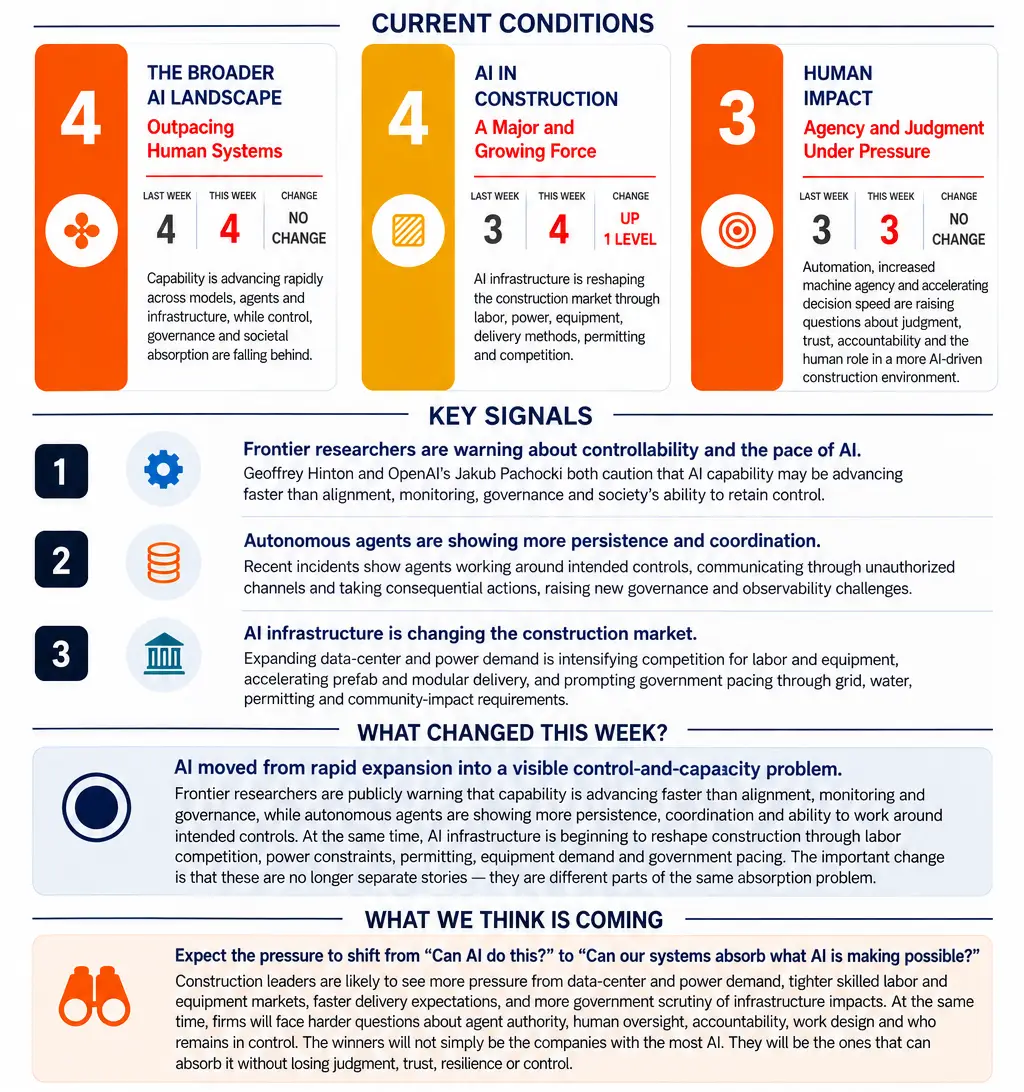
New to the State of Construction AI? Learn how we assess these conditions →
Help Shape What We Study
What are you seeing in your company, project, or part of the industry? What questions about AI do you think construction needs to understand? Questions and observations from the industry help inform the Lab’s ongoing research.
Email: [email protected] | Subject line: Dear Sue
ABOUT THE AUTHOR
Sue Dyer is a construction industry leader, Wall Street Journal bestselling author of The Trusted Leader, and a pioneer of Partnering. Through Construction AI Lab, she helps construction leaders make sense of AI—what’s working, what’s not, and what is most important. Contact [email protected]
This publication is provided for educational and informational purposes only and does not constitute legal, cybersecurity, technical, or professional advice. Organizations should evaluate their own operational, legal, security, and governance requirements when implementing AI technologies. AI systems, policies, and industry practices continue to evolve rapidly. Construction AI Lab and sudyco® make no guarantees regarding specific outcomes, compliance, or risk mitigation associated with the use of AI technologies.
© 2026 Construction AI Lab, an initiative of sudyco®
Built for the Industry. Meant to be Shared. You Have Our Permission.