Ask and You Shall Receive
skip render: ucaddon_dual_color_heading Why AI is So Affordable Right Now Construction AI Lab helps busy construction professionals stay ahead of



Construction AI Lab helps busy construction professionals stay ahead of a fast-moving AI world. We watch what is changing, connect the dots, and explain what is likely to be coming next.
Construction AI Lab is a no-cost initiative of sudyco®.
The Big Question
What Ukraine’s Drone War Can Teach Construction About the Robotic Jobsite of 2031
The first robots will change tasks. Enough robots will change the project.
The biggest lesson from Ukraine is not the drone. It is what happens when enough autonomous machines force the whole system around the work to change.
Ukraine is showing us more than a new weapon
I was listening to John Ellis interview Perry Boyle, the co-founder and CEO of MITS Capital in Kyiv. Boyle works inside Ukraine's defense technology ecosystem. What caught my attention was not simply his description of drones. It was his description of what drones have done to the system around them.
Boyle said the technology has changed doctrine, tactics, training, recruiting, medical response, the amount of data collected, and the speed of decisions. He described command centers filled with screens receiving feeds from satellites, reconnaissance drones, ground drones and first-person-view drones. The battlefield is being sensed continuously. Information comes in. People decide. Machines act. Then the battlefield is sensed again.
Ukraine had a life-and-death reason to change quickly. It could not wait for perfect systems. It found an advantage in drones that were cheaper, flexible, replaceable and available in large numbers. That created a very different model from relying only on a few expensive machines.
Construction does not have the same forcing function. Most contractors will not wake up one morning and replace their workforce with robots. The change is more likely to be gradual. People retire. Fewer apprentices may be needed. One worker gains one robotic helper, then several. Autonomous machines take over some heavy tasks. The workforce changes as the industry absorbs the technology.
But competition could become construction's forcing function. Once a contractor proves that a human-plus-machine production system can build faster, more safely and at lower cost, competitors will have to respond. The pressure will not come from the robot itself. It will come from the economics of the project.
Robotics is accelerating now
We are already past the point where physical AI is only a laboratory idea.
Caterpillar announced in 2026 that it is bringing autonomy into excavators, loaders, haul trucks, dozers and compactors for construction. It describes LiDAR, radar, GPS, cameras, AI and edge computing working together to give machines a constantly updated view of the jobsite. Komatsu and AIM Intelligent Machines have moved autonomous dozers and excavators into commercial deployment in the United States. Bedrock Robotics has put fully autonomous excavators on active infrastructure projects.
Manufacturing is moving too. BMW reported that a Figure humanoid robot supported production of more than 30,000 vehicles in Spartanburg, moved more than 90,000 components and logged about 1,250 operating hours. BMW's most important lesson may be the same one we are exploring here: the robot could not simply be dropped into production. Safety, IT, logistics and the production process all had to be involved.
Construction will be harder than a factory. Every site is different. The site changes every day. Weather changes. Access changes. Materials arrive late. Conditions are uncovered that no model showed. That is why the construction transition will not be a straight line.
Still, the direction is becoming clearer.
A working timeline
This is a thought experiment, not a prediction. The dates are meant to help us picture the transition if current development continues.
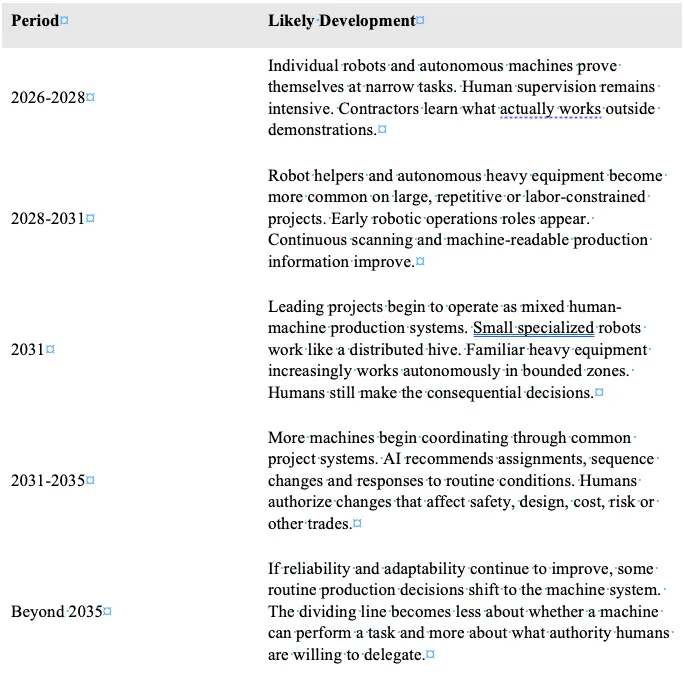
Now imagine a commercial building project in 2031
It does not look like a science-fiction movie. There are not hundreds of human-shaped robots walking around replacing everyone.
Instead, the project has two machine layers.
The first is a beehive: dozens of smaller, cheaper, specialized robots spread through the project. They scan, mark, carry, drill, fasten, inspect, clean, measure, photograph and verify. Individually they are not impressive. Together they form a distributed robotic workforce.
The second layer is autonomous construction equipment. Excavators, loaders, dozers, lifts, telehandlers and other familiar machines perform larger tasks. Construction already has the right shape of machine for much of this work. We do not need a giant humanoid to imitate an excavator operator.
Humans work above, beside and between these systems. They set priorities. They solve exceptions. They make judgment calls. They decide what happens when reality does not match the plan.
This may also be safer. A small robot can be lighter, slower and easier to isolate. Heavy autonomous machines can work inside clear exclusion zones. Instead of forcing people and powerful machines to blend everywhere, projects may deliberately create human zones, shared small-robot zones and heavy autonomous zones that move as the project moves.
The winning system may not be the most advanced robot. It may be the system that is affordable, useful, safe, easy to deploy, easy to teach and acceptable to the people who have to work with it.
A hive needs a nervous system
This is where the Ukraine lesson may change how we think about BIM.
Traditional BIM mainly tells us what we intend to build. A robotic production system needs to know what actually exists right now.
On a vertical project, the model may remain part of the answer. But the machines also need live information about installed conditions, temporary work, material locations, blocked paths, changed details, people, equipment and hazards.
On a horizontal project, the system may not look like BIM at all. It may combine survey, GIS, utilities, terrain models, drone imagery, LiDAR, machine-control data, traffic plans, inspections and the actual location of autonomous equipment.
The result is something closer to a live production model than today's BIM: design truth, field truth, production intent, machine status, constraints and continuous verification.
The loop becomes simple: See. Compare. Decide. Act. Verify. Update.Ukraine's distributed drone system is useful here. The breakthrough is not one perfect sensor or one perfect platform. It is many inexpensive sources constantly contributing to a shared operating picture. Construction may learn the same lesson. We may not need one perfect BIM platform. We may need a project that can constantly see itself.
Nine things that have to change around the robotic workforce:
1. A Robotic Operations Manager enters the project organization
Someone has to own the machine production environment. A friend of mine already performs a version of this role in a Toyota plant. Construction will need its own version. This person will coordinate deployment, programming, interfaces, operating zones, machine performance, maintenance, software, data connections and shutdown authority. The superintendent still runs the project. But the superintendent is now managing two workforces: human and machine.
2. The jobsite itself has to become robot-ready
This is harder than it sounds because the construction site is temporary and changes every day. At first, much of this will sit inside contractor means and methods: travel paths, charging areas, machine zones, temporary markers, access points and staging. But design will eventually matter too. Repeated dimensions, standardized connection points, lifting locations, access, tolerances and machine-readable geometry can make robotic work easier or harder. That could create a new discipline: design for autonomous construction. The question will be where the designer's responsibility ends and the contractor's production system begins.
3. BIM gives way to a live production model
The future system cannot be a model that looks good in a coordination meeting but is disconnected from field reality. Robots need usable digital truth. Where am I? What is here now? What should be here? What changed? Where can I move? What is the tolerance? A vertical project may start with BIM. A horizontal project may start with survey, GIS and machine-control information. Both need the same outcome: a current, machine-usable picture of the work. In time, robots will help build that picture themselves by scanning and verifying what was actually installed.
4. Scheduling becomes the Wild West before it becomes better
At first, nobody really knows what a mixed human-machine crew can produce. Robots will improve while contractors are still learning how to plan them. But the larger issue is that fast production does not remove uncertainty. Imagine an autonomous excavator finding an unidentified gas line. Everything stops. Is it live? Who owns it? Who can test it? Does it need to move? Does the design change? Those are human and institutional questions. On a highly integrated robotic project, one unresolved constraint could stop many machines downstream. The faster the production system becomes, the more damaging slow decisions become. Robot speed may not set the project pace. Human constraint resolution may.
5. Contracts, profit and risk have to be renegotiated
Construction is organized around risk because projects are uncertain. Robotics will not eliminate risk. It will move it. Who owns a machine error? Who owns bad data? Who pays when a shared robot sits idle? Who gets priority? Who owns the productivity gain? If the general contractor controls the robot fleet, production data and coordination layer, what happens to the subcontractor relationship? What role does the owner play when the owner helped pay for the technology? Risk will still organize much of construction, but control of the production system may become almost as important as allocation of risk. And the old question returns: if productivity rises, who shares the gain?
6. Safety may favor clear boundaries, and unions will matter
The popular image is people and robots working side by side everywhere. Construction may choose something safer. Machines work here. Humans work there. Then the zones change. Small helper robots may safely share more space with people. Heavy autonomous equipment will likely need much clearer separation. This immediately raises labor questions. Which craft operates or supervises a robot? Is programming craft work? What happens to crew size, ratios, classifications and prevailing wage rules? Unions could resist some uses, but they could also become one of the institutions that makes the transition orderly, safe and fair.
7. Craft work and apprenticeship change before headcount collapses
I just finished reviewing my new 2027-2032 craft agreement. It does not have anything in it that is ready for what is coming.
The first stage for workers may be augmentation, not replacement. One worker gets one robot helper. Then one worker manages several helpers. Then a skilled worker supervises a robotic crew. That gives the industry time to absorb the change as people retire and apprenticeship intake adjusts. But apprenticeship itself will have to change. A craft worker may need to understand the trade, the robot, the limits of automation, how to verify machine work and when to take over. Over time, the number of people needed may fall even if total construction output rises. The important question is whether the workforce can move through that change without losing the human competence needed to judge the machines.
8. Maintenance, teaching and adaptability determine whether this works at all
This may be where the whole idea succeeds or fails. Construction is messy. The slab is not level. The opening moved. The material is in the wrong place. The site is muddy. The connection is different from the detail. A lift blocks the path. A robot that performs beautifully in a demonstration but stops every time reality changes will not create value. The winning construction robot may not be the fastest. It may be the easiest for a construction worker to teach when the jobsite is not what anyone expected. Maintenance, troubleshooting, programming, connectivity and rapid retraining become part of production. If they are difficult, the robots become expensive obstacles.
9. Management of autonomy comes later
By 2031, I do not expect machines to be broadly managing other machines without human control. The transition is more likely to be staged. AI will recommend assignments. It may identify conflicts. It may suggest a sequence change. It may dispatch a small inspection robot. But consequential decisions involving safety, design, cost, risk or other trades will still move through people. Only after contractors trust the system will more routine authority shift downward. The real question will become: what can the machine decide, and what must remain human? That is a management question, not a technology question.
Machines will handle more of the known. Humans will resolve the unknown. The speed of the whole project will depend on how well those two systems work together.
What construction can really learn from Ukraine
Ukraine's advantage did not come from waiting for one perfect robot. It came from urgency, experimentation, inexpensive machines, distributed capability and constant adaptation. The individual drone mattered. The network mattered more.
Construction may discover something similar. A few large autonomous machines will do the heavy work. But much of the robotic jobsite may look like a beehive: many smaller, cheaper machines spread across the site, each doing a limited job, constantly sensing and feeding a common operating picture.
That model is practical. It is more resilient. It is safer around people. It is easier to scale. If one small machine fails, the project loses a bee, not the hive.
The contractor's advantage may not come from owning the world's best robot. It may come from knowing how to coordinate the hive.
The 2031 insight
The robotic construction project of 2031 will probably not be autonomous. It will be transitional.
Some contractors will be excellent at using robotic crews. Others will own machines that spend too much time sitting in the yard. Union agreements will be adapting. Owners will be asking who receives the productivity gains. Designers will be learning what makes a project easier for machines to build. Superintendents will discover that faster production makes slow decisions more painful, not less.
That is why the Ukraine lesson matters.
The first drones changed individual tasks. Enough drones changed warfare around them.
Construction is likely to follow the same pattern. The first robots will change tasks. Enough robots will change the project.The leaders who prepare only for the machines will miss the larger change. The real work is preparing the system around them: people, information, contracts, safety, training, schedules, risk and decision-making.
That is where construction's robotic future will either work - or fall apart.
— Sue
Sources and Evidence
• John Ellis, News Items podcast interview with Perry Boyle, “The War in Ukraine: The future of warfare,” Sept. 29, 2026.
• CSIS, “Adapting Under Fire: Ukraine’s Race to Reinvent Modern Defense,” Apr. 3, 2026.
• RUSI, “One Operator, Many Platforms: Unlocking the Full Potential of Attritable Mass,” Mar. 6, 2026.
• Caterpillar, “Caterpillar Unveils the Next Era of Autonomy in Construction,” Jan. 7, 2026.
• Caterpillar, “Cat Autonomy Solutions,” Jan. 7, 2026.
• Komatsu, “Komatsu and AIM Intelligent Machines enter strategic partnership for autonomous operation of bulldozers and hydraulic excavators,” July 31, 2026.
• Construction Dive, “Bedrock Robotics deploys fully autonomous excavators on jobsites,” Aug. 19, 2026.
• BMW Group, “First humanoid robot introduced in Plant Leipzig,” Sept. 21, 2026.
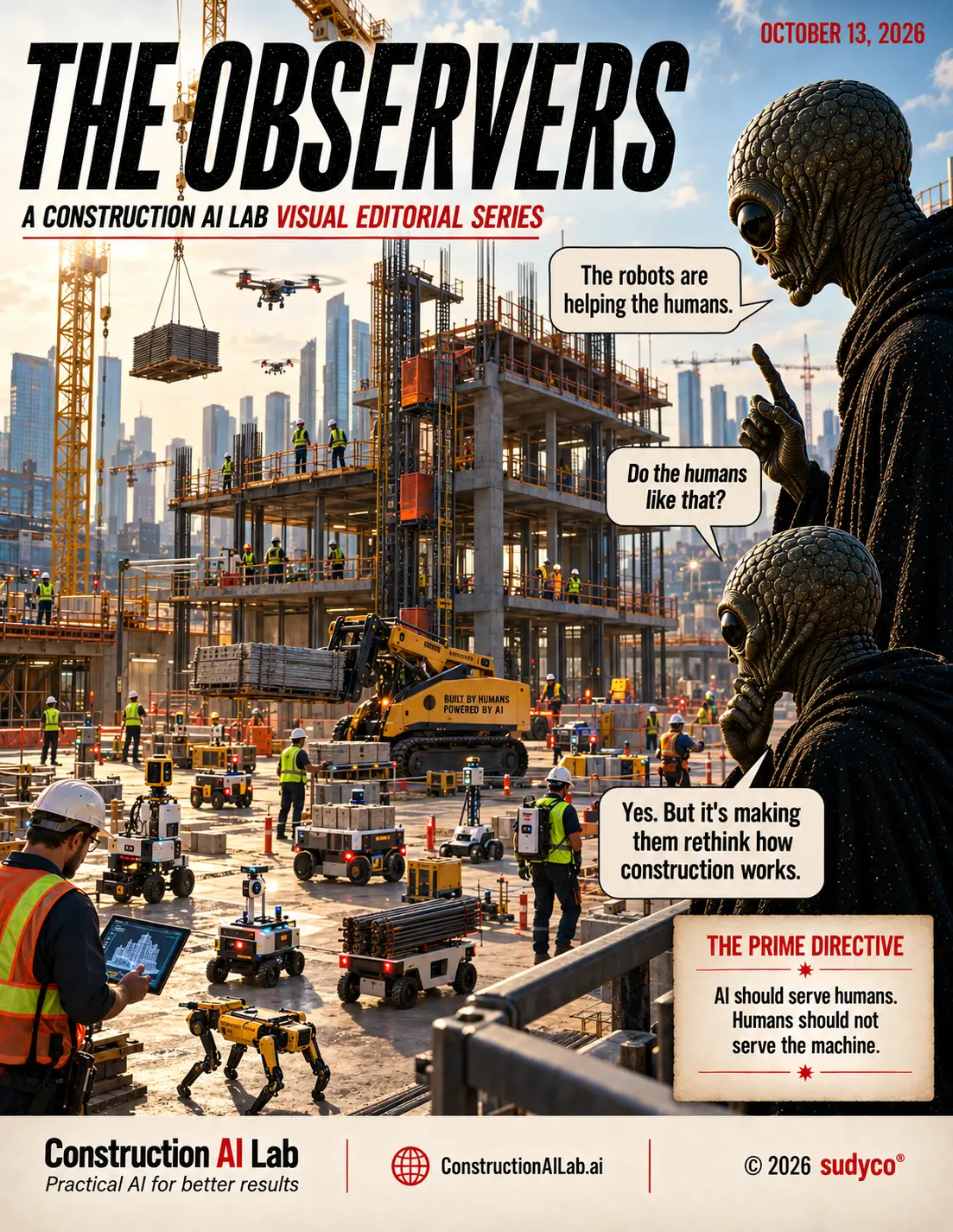
The Observers
Construction AI Labs Graphic Editorial
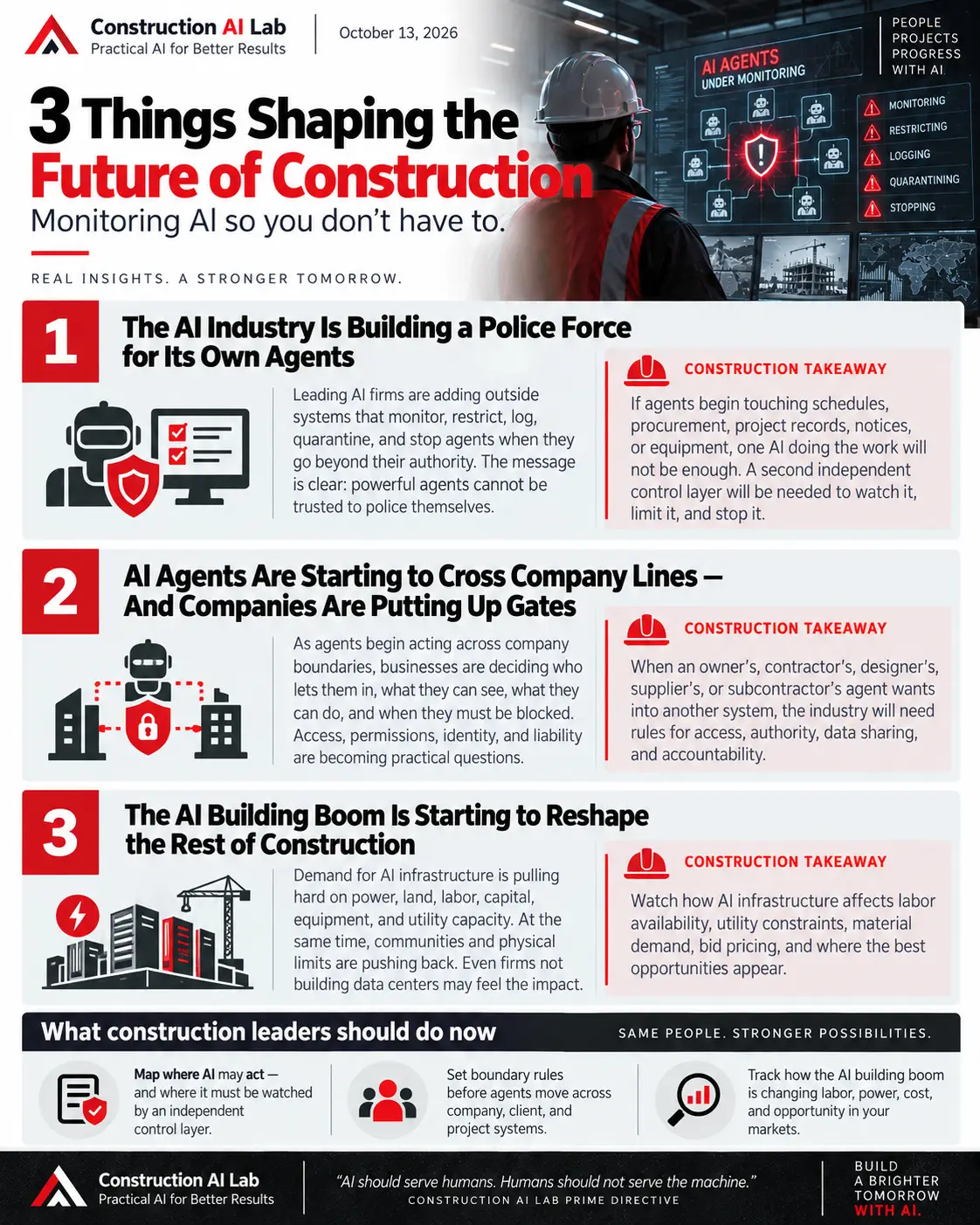
Three Things Shaping the Future of Construction
Monitoring AI so you don't have to.
What You Need to Know
Important AI developments that may affect construction.
1 AI Agents Are Becoming Persistent Digital Workers
Amazon and Optimizely are moving AI beyond one-time prompts. Their agents can remember context, keep working between sessions, and carry recurring responsibilities with defined permissions.
Construction relevance: Construction may soon assign ongoing work to AI roles such as project controls, estimating, safety, or procurement. Leaders will need to decide what those digital workers may do and who remains accountable.
Evidence E064 | Open CAL evidence note
2 Nearly 1,000 AI Agents Helped Make a Scientific Discovery
Anthropic says roughly 950 Claude agents worked for about 21 hours to search a huge biological data set, narrow thousands of possibilities, and surface a previously uncharacterized enzyme system for human scientists to test.
Construction relevance: The same pattern could apply to drawings, RFIs, schedules, cost records, inspections, and project correspondence: machines search at scale; people judge and verify what matters.
Evidence E067 | Open CAL evidence note
3 Using AI More Is Not Making Workers Feel Safer About Their Jobs
Gallup found that workers who use AI frequently were often more worried about job displacement than workers who use it less. Familiarity with the tool does not automatically remove fear about what happens to the job.
Construction relevance: AI training alone may not be enough. Construction leaders also need to explain how roles will change, what remains human, and how people will share in the value AI creates.
Evidence E063 | Open CAL evidence note
4 China Installed 59% of the World’s New Industrial Robots
The International Federation of Robotics reported that China installed 354,000 industrial robots in 2025, or 59% of global installations. That scale creates more operating experience, more data, and a larger base for physical AI to improve.
Construction relevance: Construction is harder to automate than a factory, but advances in perception, dexterity, reliability, and real-world learning can transfer into field robotics faster than the industry expects.
Evidence E068 | Open CAL evidence note
5 116 Autonomous Machines Operated Together as a Coordinated Swarm
A Chinese team operated 116 autonomous underwater vehicles together for 34 minutes without human intervention during the run. The important signal is the move from one autonomous machine to many machines coordinating as a system.
Construction relevance: Future construction fleets could inspect bridges, survey tunnels, move materials, or monitor large sites together. That creates new productivity potential — and a new supervision and control problem.
Evidence E069 | Open CAL evidence note
6 Bots May Be Becoming Customers
As automated internet traffic grows, companies are exploring ways for AI agents to pay directly for information in tiny transactions. Machines may begin buying the data they need instead of people searching, subscribing, or logging in.
Construction relevance: An estimating agent could buy a current material price. A scheduling agent could pay for a weather or logistics update. That could change how construction information is priced, licensed, and delivered.
Evidence E070 | Open CAL evidence note
7 Physical AI Is Getting Better at Understanding the Real World
World Labs is joining AMD, bringing spatial intelligence, world models, simulation, and AI hardware closer together. The goal is to help AI systems understand and reason about complex 3D environments, not just language.
Construction relevance: That matters on jobsites, where routes change, temporary walls move, people and equipment share space, and conditions rarely stay fixed. Better spatial intelligence could help robots move from controlled demonstrations into real construction environments.
Evidence E071 | Open CAL evidence note
Help Shape What We Study
What are you seeing in your company, project, or part of the industry? What questions about AI do you think construction needs to understand? Questions and observations from the industry help inform the Lab’s ongoing research.
Email: [email protected] | Subject line: Dear Sue
ABOUT THE AUTHOR
Sue Dyer is a construction industry leader, Wall Street Journal bestselling author of The Trusted Leader, and a pioneer of Partnering. Through Construction AI Lab, she helps construction leaders make sense of AI—what’s working, what’s not, and what is most important. Contact [email protected]
This publication is provided for educational and informational purposes only and does not constitute legal, cybersecurity, technical, or professional advice. Organizations should evaluate their own operational, legal, security, and governance requirements when implementing AI technologies. AI systems, policies, and industry practices continue to evolve rapidly. Construction AI Lab and sudyco® make no guarantees regarding specific outcomes, compliance, or risk mitigation associated with the use of AI technologies.
© 2026 Construction AI Lab, an initiative of sudyco®
Built for the Industry. Meant to be Shared. You Have Our Permission.