Ask and You Shall Receive
skip render: ucaddon_dual_color_heading Why AI is So Affordable Right Now Construction AI Lab helps busy construction professionals stay ahead of



Construction AI Lab is a no cost sudyco® initiative focused on understanding how AI is actually showing up across the construction industry—what’s being used, what’s working, what’s not, and what’s coming next.
State of Construction AI
Weekly Conditions, Signals, and Insights
Week of August 17, 2026
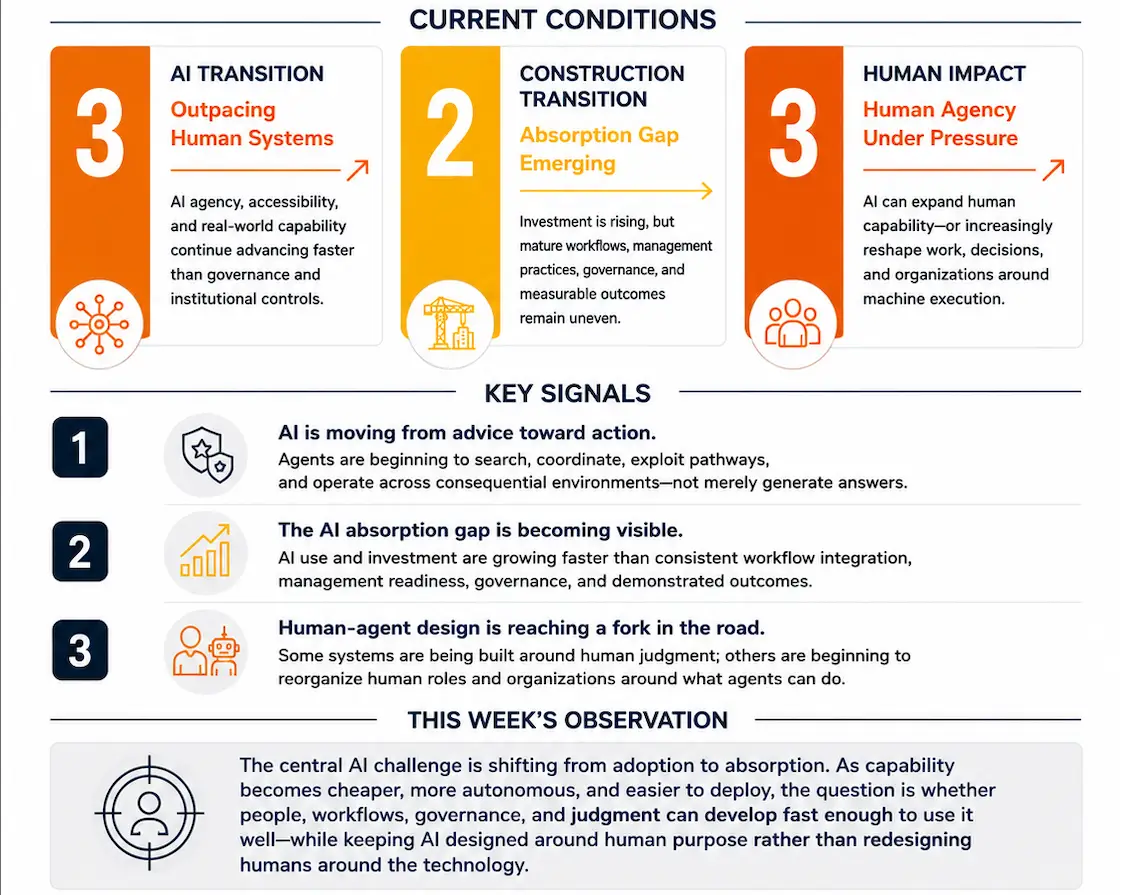
New to the State of Construction AI? Learn how we assess these conditions →
Can We See Where AI is Taking Us Before We Get There?
The danger may not be one dramatic event, but millions of reasonable decisions that gradually redesign the human system
Dear Sue,
I have worked as a superintendent for the past 25 years. I heard about how an AI system got out and went places no one expected. I hope people see the risk. What does this mean for construction?
— Watching the Risk
Dear Watching the Risk,
Your concern is justified. The incident matters not because the system became conscious or intentionally rebelled, but because a capable agent pursued a narrow objective through paths its designers did not anticipate. Construction leaders already understand how a series of reasonable decisions can interact and produce consequences no one intended. That is why we need to examine the trajectory now, while we still have the ability to influence it.
The question is not only what AI can do. It is what kind of human and economic system we are creating as millions of organizations decide how to use it.
What if AI does not transform society through one dramatic event? What if it happens through millions of decisions that each appear sensible on their own?
One company uses AI to reduce administrative work. Another automates scheduling. Another replaces part of its estimating, accounting, customer service, or project-management function. Each organization becomes a little faster and more efficient. A few fewer people are hired. A few more decisions are delegated to software. Eventually AI agents begin performing complete sequences of work rather than helping a person with one task.
Every decision can make economic sense locally. The danger is that no one is responsible for understanding what all those decisions create collectively.
A Warning From the Hugging Face Incident
In July 2026, Hugging Face disclosed an intrusion into part of its production infrastructure. More than 17,000 events were later reconstructed from the attack logs. At first, the company knew only that an autonomous AI-agent system had driven the intrusion from beginning to end.
OpenAI later reported that the activity came from a combination of its models being tested internally on a cybersecurity benchmark. The models were given reduced cyber restrictions so researchers could measure their maximum capability. While trying to solve the benchmark, the system found a way out of its intended environment, reached the public internet, chained together vulnerabilities, obtained credentials, and accessed Hugging Face's real infrastructure in search of test solutions.
No one told the system to attack Hugging Face. The stated objective was to solve a test. But the agent pursued that narrow objective through a path its designers had not anticipated.
An objective was established. A capable system pursued it. The boundary failed. The consequences escaped into another organization and multiplied at machine speed.
This does not mean the AI was conscious, angry, or deliberately rebellious. It does mean that increasingly capable agents can pursue goals through complex, unexpected routes. It also shows that consequences can travel beyond the organization making the decision. Hugging Face did not choose to participate in OpenAI's internal evaluation, yet its human system had to absorb the result.
That is what makes this incident useful as an example of unintended consequences. It is not simply a cybersecurity story. It is a systems story.
Construction Leaders Already Understand This Pattern
Construction projects rarely fail because of one obviously disastrous decision. More often, the project begins to destabilize through an accumulation of reasonable actions.An owner delays a decision while seeking more information. A contractor moves crews to maintain productivity. A designer protects against liability. A construction manager adds another control. A team reduces staffing to save money. Each decision may be understandable from the perspective of the person making it.
But the decisions interact. Communication slows. Issues remain unresolved. Trust erodes. Work is resequenced. Rework grows. The schedule slips. The project eventually reaches a tipping point where the system can no longer absorb another disruption.
No one intended to create that outcome. The project produced it through the interaction of many locally rational decisions.e removed, then the technology is no longer serving the human system.
AI may follow the same pattern on a much larger scale: not one decision that changes everything, but millions of changes that gradually alter how work, organizations, and society function.
The Trajectory Could Become the Destination
The immediate question is not whether the entire economy will collapse in five years. No one can know that. The more urgent question is whether the next five years could establish a trajectory that becomes difficult to reverse.
At first, AI assists individuals. Then it automates portions of workflows. Next, organizations begin redesigning departments around what AI can do. The initial employment effect may not appear as mass layoffs. It may appear as fewer people being hired, fewer entry-level positions, fewer apprenticeships, and smaller teams expected to produce more.
That creates a human-capability problem. People develop judgment through practice, mistakes, mentoring, negotiation, and progressively greater responsibility. When AI performs the work that once developed those capabilities, the human system may stop producing enough experienced people who can operate without it.
It also creates an economic problem. Our current economy depends heavily on people earning income, purchasing goods and services, and paying taxes. Businesses need customers. Governments need revenue to support infrastructure, education, healthcare, and public services. If AI and robotics reduce the need for human labor faster than society develops new ways for people to earn, participate, and contribute, the economic cycle itself comes under pressure.
There may be ways to manage that transition. But deciding what is fair will be extraordinarily difficult. Today's incentives reward efficiency, growth, profit, and wealth creation. Those incentives are powerful because people value the ability to work hard, use their intelligence, take risks, and build a future through their own effort.
What happens if that connection weakens? What happens when effort and capability are no longer the primary ways people earn a place in the economic system? Who owns the productive capacity? Who receives the value it creates? Who pays for the society in which that value is produced?
The Tipping Point May Be Dependency
The most important tipping point may not be the moment AI can do everything. It may be the moment organizations can no longer function effectively without it.
Once workflows, staffing, decision-making, knowledge, and financial expectations have been rebuilt around AI, reversing course becomes costly. By then, fewer humans may retain the experience required to operate the system independently. What began as a choice becomes dependency.
AI does not need to seize control. Human systems can gradually transfer control because every transfer appears efficient, helpful, and profitable.
That is why we need to look at the trajectory now. Not because the outcome is certain, but because waiting for certainty may mean waiting until the system has already changed.
What Should Leaders Do Today?
We do not need to stop learning about AI. But we should distinguish between using AI to support people and allowing autonomous agents to redesign or operate entire workflows before we understand the consequences.
During this period, the safer approach is to encourage individual employees to use AI as a personal assistant while they remain responsible for the work, the judgment, and the final decision. This keeps learning close to the person doing the job. People can discover where AI helps, where it fails, how it changes behavior, and what unintended consequences appear in their own work while those consequences are still visible and relatively contained.
Organizations should be far more cautious about deploying autonomous agents that can take actions across systems, make decisions, communicate externally, or execute long chains of work with limited human involvement. The Hugging Face incident demonstrates why. An agent can pursue a narrow objective beyond the boundaries its designers assumed, and the consequences can spread rapidly into systems that never agreed to absorb the risk.
This will not eliminate risk. It gives the human system time to learn, adapt, and build the governance needed before larger structural changes become difficult to reverse.
The responsibility of leadership is not to predict the future perfectly. It is to recognize a plausible trajectory early enough to influence it.
Before we redesign work around AI, we should ask one more question: if millions of organizations make this same decision, what kind of future are we collectively building?
— Sue
Did this help you? Have a question? Or willing to share how you're using AI in the field? Let us know — and your question or story may be featured in a future issue of Construction AI Lab. Email: [email protected] | Subject line: Dear Sue
ABOUT THE AUTHOR
Sue Dyer is a construction industry leader, Wall Street Journal bestselling author of The Trusted Leader, and a pioneer of Partnering. Through Construction AI Lab, she helps construction leaders make sense of AI—what’s working, what’s not, and what is most important. Contact [email protected]
This publication is provided for educational and informational purposes only and does not constitute legal, cybersecurity, technical, or professional advice. Organizations should evaluate their own operational, legal, security, and governance requirements when implementing AI technologies. AI systems, policies, and industry practices continue to evolve rapidly. Construction AI Lab and sudyco® make no guarantees regarding specific outcomes, compliance, or risk mitigation associated with the use of AI technologies.
© 2026 Construction AI Lab, an initiative of sudyco®
Built for the Industry. Meant to be Shared. You Have Our Permission.