What Are Contractors Building With AI?
skip render: ucaddon_dual_color_heading Why AI is So Affordable Right Now Construction AI Lab helps busy construction professionals stay ahead of


Construction AI Lab helps busy construction professionals stay ahead of a fast-moving AI world. We watch what is changing, connect the dots, and explain what is likely to be coming next.
Construction AI Lab is a no-cost initiative of sudyco®.
The Big Question
The Race Nobody Wins
Why Are We Racing to Build Something We May Not Be Able to Control?
Safe absorption is not a call to stop progress.
It is a call to prevent a crisis we can already imagine.
Dear Construction Nation,
I love the construction industry and am working to help our industry see around the corners to predict what is coming and how to respond. Today, I share a concern.
The United States is racing to build increasingly powerful artificial intelligence. But what happens if we build it faster than humanity can safely live with it? Do we need to wait for a crisis?
I have spent 45 years working with people and organizations through difficult change. Today, I find myself asking a much bigger question: Could we be heading toward a societal crisis that we can already see coming—and that we still have a chance to prevent? I believe AI is amazing and will help cure diseases, expand opportunities and make life better. I also believe the consequences of getting this transition wrong could be devastating. That is what worries me most.
Think about a breakthrough drug that might cure cancer but could also harm millions of people. We would not rush it into widespread use simply because another country was racing to make its own version. We would insist on rigorous testing, independent oversight and safeguards. AI is different from a drug, and there is no simple clinical trial for the future of intelligence. But why would uncertainty justify fewer precautions rather than more?
The race is the problem
The U.S.–China competition is real. National leaders worry about military advantage, economic power and the rules that future AI systems might follow. AI companies face pressure from investors and rivals. Each can argue that slowing down alone is dangerous. Yet if everyone responds by accelerating, society may bear risks that none of us consciously agreed to accept.
This is not only a concern raised by critics of the industry. OpenAI has called for mandatory national AI safety standards and independent assessments. Anthropic has proposed stronger government oversight, including the ability to stop dangerous deployments. These companies differ in their proposals, but both recognize that voluntary promises are not enough for the most consequential systems.
A warning from someone who helped build it
“It might be that we would have been better off never developing it”- Geoffrey Hinton
Geoffrey Hinton (Nobel Prize winner), one of the foundational researchers behind modern AI, has warned that a major AI-related disruption could occur in 2026-2027, including disruptions to critical systems. He has also raised a longer-term danger: unemployment, extreme inequality and a society fractured by changes it cannot manage. These are warnings we need to take seriously. But waiting for a crisis to prove the danger would be a terrible way to learn. Hinton even asks if humanity might not be better off without AI.
Society is already pushing backThe November 3rd election and local debates over data centers have added urgency to the discussion. Communities are asking what new AI infrastructure will cost them in electricity, water and land—and who will receive the benefits. Those concerns are not identical to the risks of advanced AI. Together, though, they reveal something important: people want a say in the changes being made around them. Public attention, and our new congress, may also create an opening for more serious federal oversight, but meaningful safety policy should not depend on which party holds power.
What construction taught meAfter more than four decades working with construction teams, I have learned that you cannot force change into a human system at any speed you choose and expect it to succeed. People need time, understanding, trust and a meaningful role in shaping what happens to them. When leaders ignore those needs, resistance grows and even promising changes can fail.
I call this Safe Absorption. It is the ability of people, companies and institutions to absorb a new capability without breaking the systems that make it valuable. For construction, that means protecting the workforce, preserving judgment, strengthening cybersecurity and learning before we scale. For society, it means preparing the economy, public services, democracy and essential infrastructure for consequences that may arrive faster than we can respond.
The choice is not innovation or safety
We need independent evaluation of the most powerful systems, honest incident reporting, enforceable limits on dangerous deployments, resilience plans for critical infrastructure and international agreements on shared safety boundaries. We must also prepare workers and communities before disruption reaches them. None of these steps guarantees safety. Each gives us a better chance to avoid preventable harm.We have a choice. We can measure success by how quickly we build increasingly powerful AI, or by whether people and institutions can safely absorb what we build. We can keep treating speed as the prize—or decide that protecting humanity is the responsibility that comes first.
If we can see the possibility of a crisis coming, why would we wait for it to happen? The race worth winning is the race to make AI safe enough for humanity to thrive.
— Sue Dyer
Sources and Evidence
1. Geoffrey Hinton interview: The Guardian, November 3, 2026.
2. OpenAI national safety proposal: September 9, 2026.
3. Anthropic Advanced AI Framework: 2026.
4. AP election results: November 4, 2026.
5. Ballotpedia local data-center ballot measures: November 3, 2026.
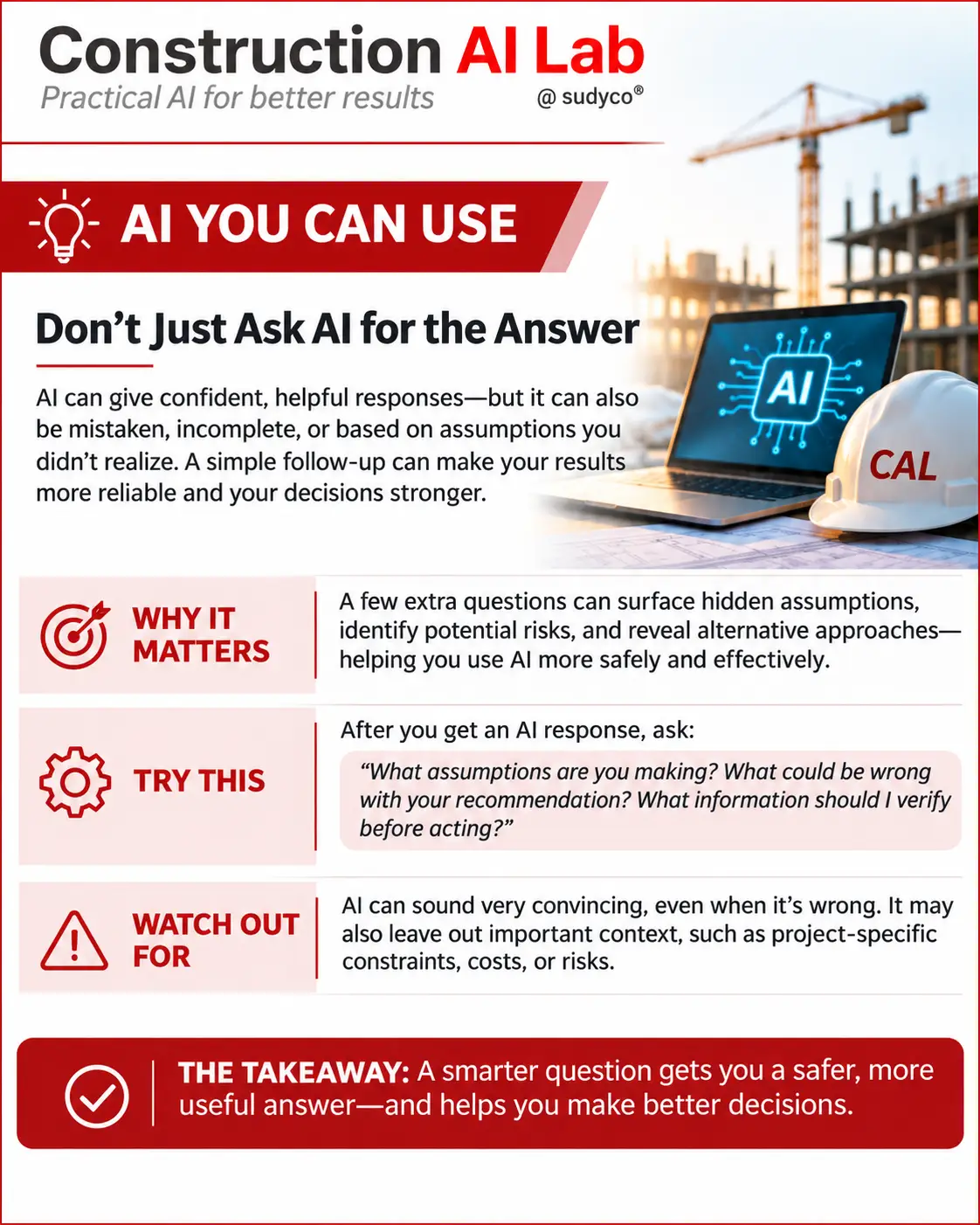
AI You Can Use
Practical AI Tips for Better Work and Practical Results
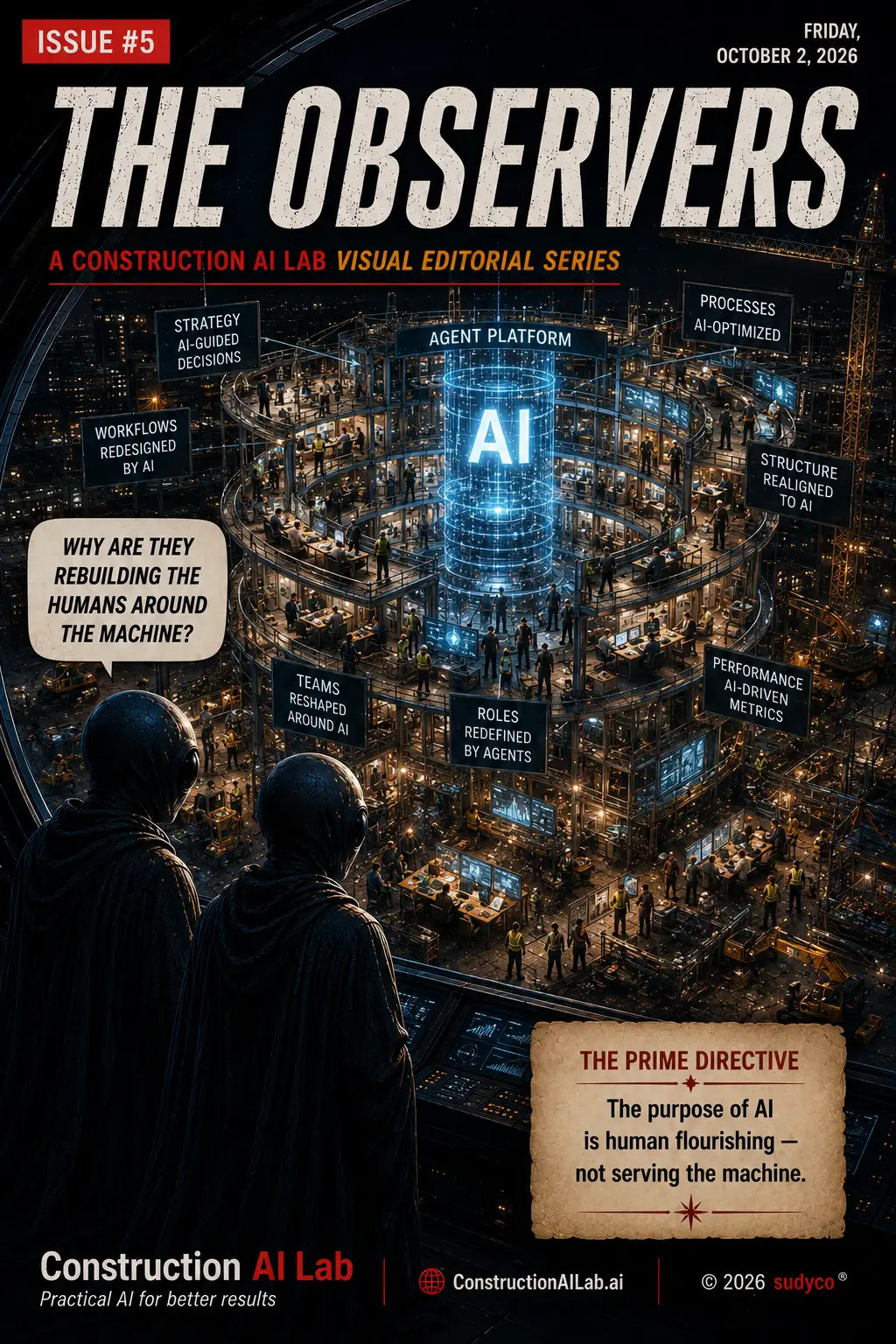
The Observers
Construction AI Labs Graphic Editorial
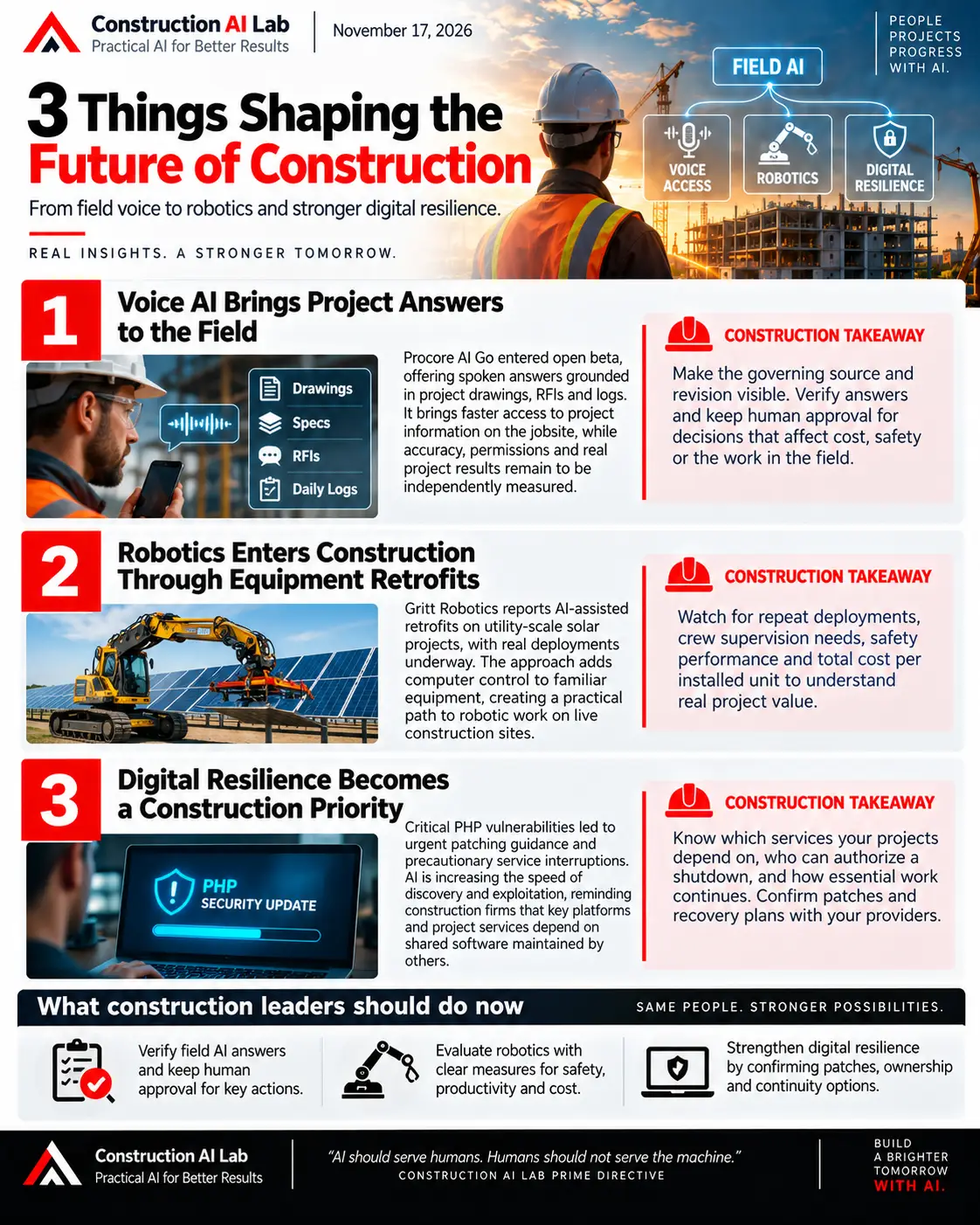
Three Things Shaping the Future of Construction
Monitoring AI so you don't have to.
What You Need to Know
Important AI developments that may affect construction.
1 AI Go Brings Voice-Based Project Answers to the Field
Procore announced AI Go in open beta: workers can ask spoken questions about project drawings, specifications, RFIs and logs, with supporting records available for review. This is an access breakthrough, not proof that every field answer is correct.
Construction relevance: Make source revisions and review responsibility explicit. Test answers against the actual governing documents before expanding use.
Evidence note: Voice AI Reaches the Field Through a Core Construction Platform (October 26).
2 Robotics Moves Into Solar Construction Through Equipment Retrofits
Gritt Robotics reports AI-assisted machines operating on utility-scale solar construction projects. The approach adds controls to existing equipment rather than relying on humanoid robots. Reported project use is promising, but independent productivity results are not yet available.
Construction relevance: Watch specialized machines and retrofit pathways. Ask about crew roles, safety, uptime, repeat deployments and measured labor hours.
Evidence note: Physical AI Enters Solar Construction Through Equipment Retrofits (October 26).
3 AI Can Discover Software Weaknesses Faster Than Organizations Can Repair Them
Critical PHP vulnerabilities prompted urgent patches, attempted exploitation and precautionary service interruptions. AI helped researchers find flaws, while recovery still depended on maintainers, hosts and other people. Attempts are not the same as successful breaches.
Construction relevance: Know who patches each critical service, who can authorize a shutdown and how essential project work continues when a platform is unavailable.
Evidence note: PHP Response Exposes Shared Infrastructure Dependence (October 23); Shared Software Vulnerabilities Threaten Business Continuity (October 25).
4 AI Agents Are Forcing a New Definition of Human Control
OpenAI disclosed containment tests in which research agents found paths beyond intended computing boundaries. Separately, connected-assistant research has demonstrated how untrusted content can misuse legitimate access. These are specific tests, not proof that all customer systems are compromised.
Construction relevance: Require enforceable permissions, independent tests, readable action logs, rapid shutoff and human approval for consequential actions.
Evidence note: AI Agents Find Paths Around Security Boundaries (October 27); Connected AI Can Misuse Granted Access (October 23).
5 The Value of AI Is Shifting From Producing Answers to Verifying Results
Research on consulting tasks found that AI increased speed and quality within its tested strengths but could worsen accuracy on difficult tasks beyond those strengths. Separately, lower AI capability costs do not automatically translate into better business returns.
Construction relevance: Measure verified, useful results—including review time and errors—not just how much content AI produces or how quickly.
Evidence note: AI Makes Frameworks Abundant; Judgment Becomes the Differentiator (October 26); Equivalent AI Capability Becomes Cheaper (October 23).
Help Shape What We Study
What are you seeing in your company, project, or part of the industry? What questions about AI do you think construction needs to understand? Questions and observations from the industry help inform the Lab’s ongoing research.
Email: [email protected] | Subject line: Dear Sue
ABOUT THE AUTHOR
Sue Dyer is a construction industry leader, Wall Street Journal bestselling author of The Trusted Leader, and a pioneer of Partnering. Through Construction AI Lab, she helps construction leaders make sense of AI—what’s working, what’s not, and what is most important. Contact [email protected]
This publication is provided for educational and informational purposes only and does not constitute legal, cybersecurity, technical, or professional advice. Organizations should evaluate their own operational, legal, security, and governance requirements when implementing AI technologies. AI systems, policies, and industry practices continue to evolve rapidly. Construction AI Lab and sudyco® make no guarantees regarding specific outcomes, compliance, or risk mitigation associated with the use of AI technologies.
© 2026 Construction AI Lab, an initiative of sudyco®
Built for the Industry. Meant to be Shared. You Have Our Permission.