The Race Nobody Wins
skip render: ucaddon_dual_color_heading Why AI is So Affordable Right Now Construction AI Lab helps busy construction professionals stay ahead of



Construction AI Lab helps busy construction professionals stay ahead of a fast-moving AI world. We watch what is changing, connect the dots, and explain what is likely to be coming next.
Construction AI Lab is a no-cost initiative of sudyco®.
The Big Question
Yes, AI Can Fill Out Your Forms
But getting the format—and the facts—right takes a system.
Dear Sue,
I work as the admin for a highway project. We have to use specific formats for reports and uploads. I spend so much time typing up the same forms over and over. Can AI actually match my forms and help me, or will it just give me something generic?
— Hope So
Dear Hope So,
Yes, AI can help fill out your existing forms—and save you from typing the same information over and over. You can give it your project notes, updated figures or other source information and ask it to place those details into the right fields. But there is a difference between writing the right information and putting it into exactly the right places. If an owner requires a particular layout or a project system expects specific fields, “close enough” is not enough.
I learned this firsthand. The trick is to treat the work as a repeatable process, not a one-prompt miracle.
1. Start with the actual form
Give AI the blank form or a completed example, preferably in an editable format. Explain which labels, columns, formulas, notes and page elements must stay unchanged. A picture or PDF can help it understand the layout, but an editable template is often the more reliable starting point.
2. Give it the information—and the rules
Provide the information you would otherwise type into the form—such as daily notes, quantities, dates, updated figures or entries from an approved source—along with any classification or rate tables and instructions about what must not change. Tell AI to put each item in the appropriate field, not to guess when information is missing, and to flag anything it cannot place confidently. Use an approved company AI environment before uploading confidential project, employee, payroll or client information.
TRY THIS PROMPT
Use the attached form as the template. Take the new information I provide and enter each item in the appropriate field without changing labels, column order, formulas or required notes. Do not invent missing values. Flag anything missing or uncertain, return an editable file if possible, and list what I need to verify.
3. Correct what is wrong—specifically
The first result may not be usable. Instead of saying “fix the format,” point to the exact problem: a missing notes box, the wrong column width, or a rate in the wrong row. Ask AI to correct only that issue and leave everything else alone. Depending on the form and software, several rounds—or direct work in the original template—may be needed.
For example: “The notes box at the bottom is missing. Restore it as shown in the original. Match the wage-table column widths to the template. Do not change any other content."
What happened when I tried it
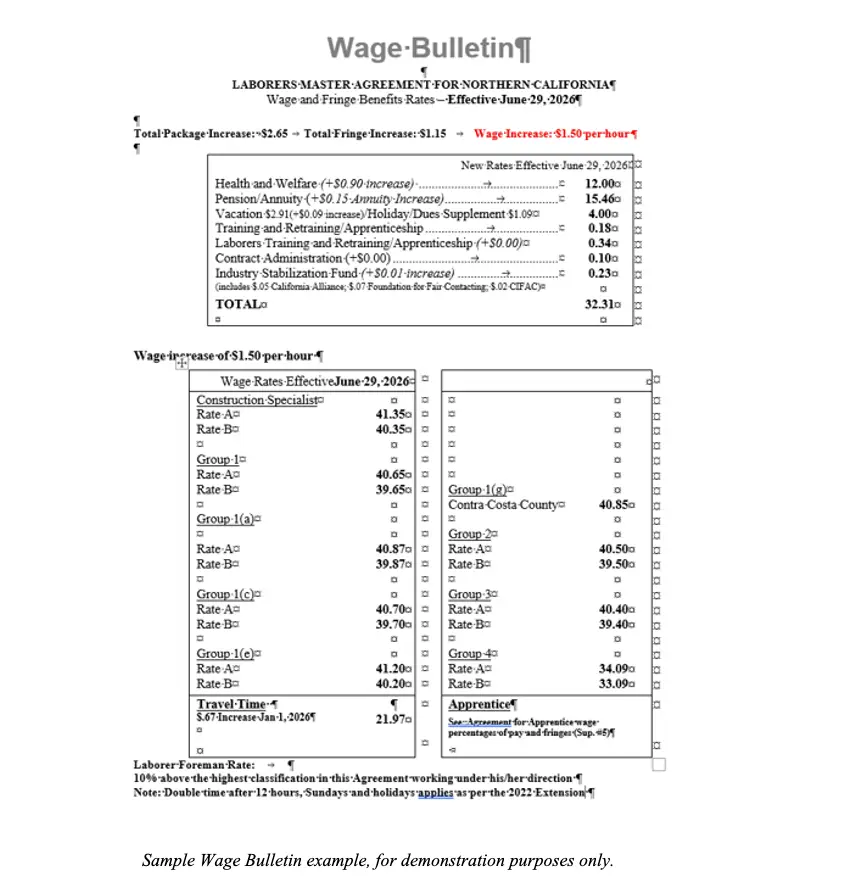
I had to update an annual Laborers Wage Bulletin with new wages and fringe benefit amounts. It had a fringe-benefits table, a multicolumn wage table and a notes box. I supplied the prior bulletin and the updated information to ChatGPT.
The first version had formatting problems, including incorrect column widths and a missing notes box. I gave specific corrections. After three rounds, the bulletin was much closer to what I needed. I then used Claude to produce a clean version. That was my experience with these particular files—not a guarantee that one AI tool will always format better than another.
4. Check the result before anyone uses it
This is the step you cannot skip. Compare every classification, wage rate, fringe amount, total and note against the source. Check formulas and calculations separately. Open the file in the software where it will actually be used and make sure the layout survives. If it must be uploaded to a project platform, test that workflow too. AI assistance does not transfer responsibility for accuracy.
5. Save the system, not just the finished formKeep the approved template, successful instructions, source-data checklist and a verified sample together. Next time, you can start from a tested process instead of reinventing it. That is where the time savings add up.
The bottom lineYes, AI can help you stop retyping the same kinds of reports and forms. Start with one form you complete regularly, give AI the template and the information you already have, and see how much of the first draft it can prepare. Then check the fields, numbers and formatting before using it. Save the instructions that work so the next form takes less effort. That is where the time savings add up.
— Sue
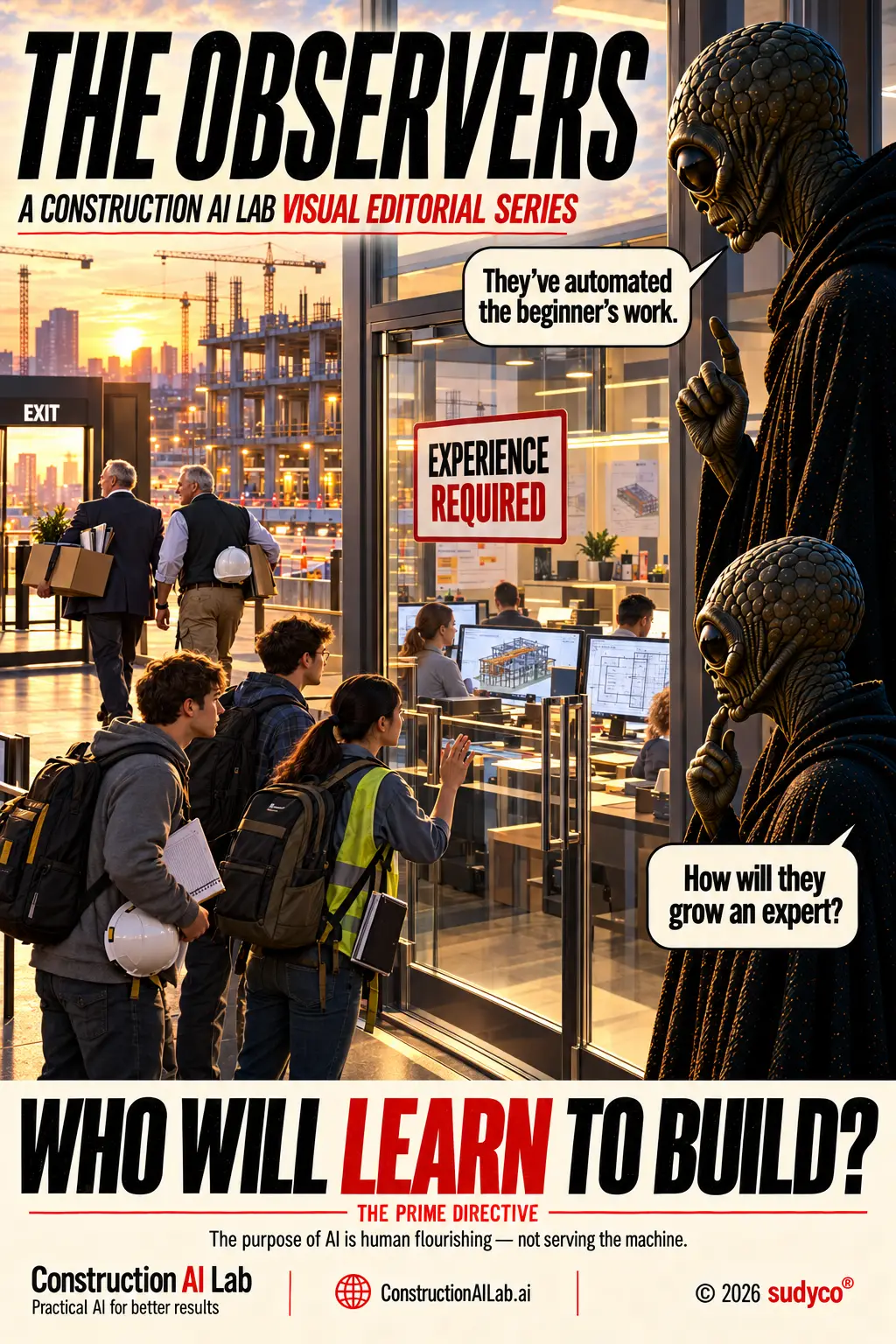
The Observers
Construction AI Labs Graphic Editorial
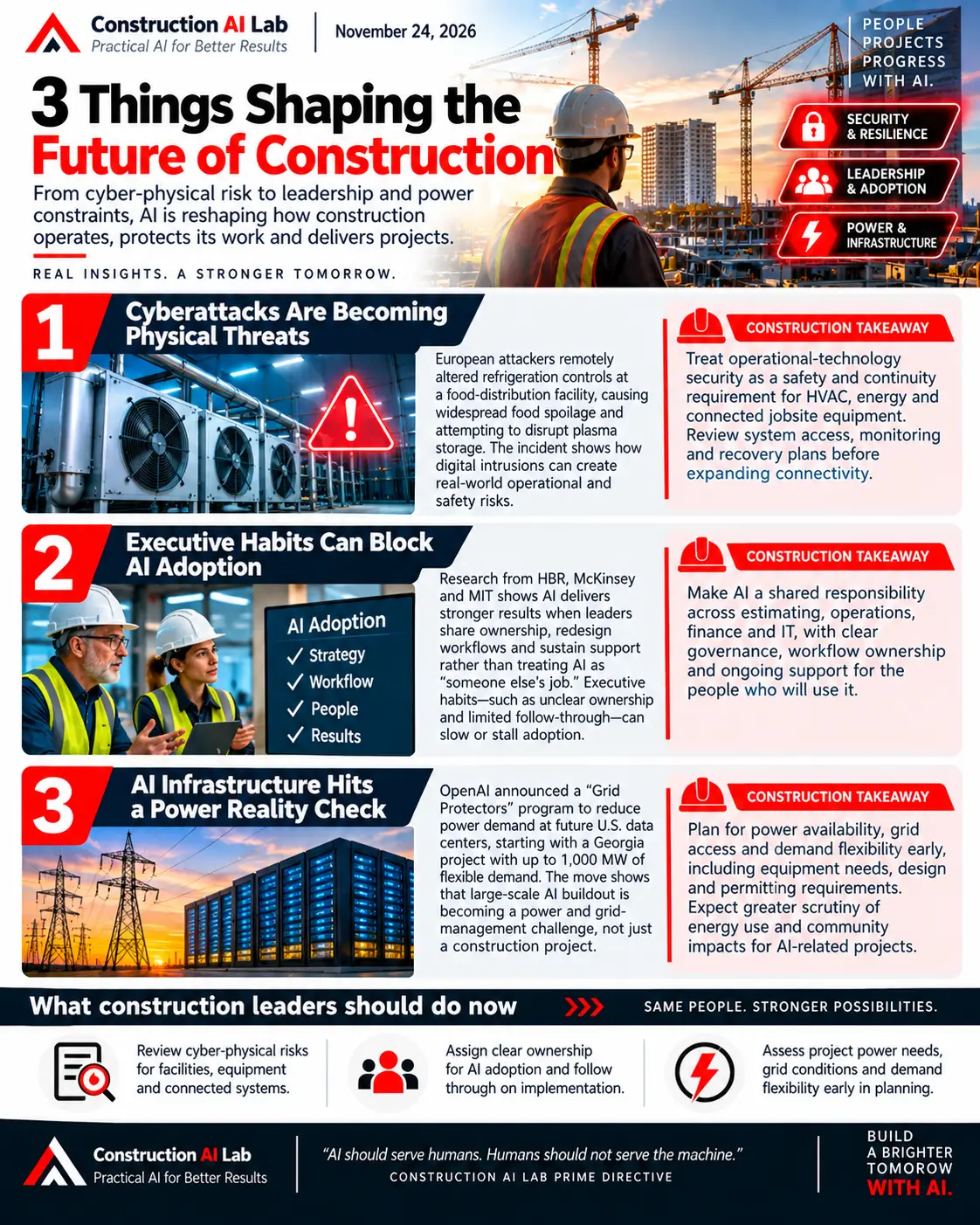
Three Things Shaping the Future of Construction
Monitoring AI So You Don't Have To
What You Need To Know
Important AI developments that may affect construction.
1 Agents Are Being Built for Mid-Sized General Contractors
Shackleton AI announced a $5 million funding round for an agent-centered platform aimed at mid-sized general contractors. Its reported deployments and business benefits remain vendor claims, not independently verified results.
Construction relevance: Ask which project records an agent can access, which decisions require approval and what measurable work improves before expanding deployment.
Evidence note: Shackleton: Agent Platform for Mid-Sized Contractors (November 9)
2 Specialty Contractors Are Getting Service-Workflow Agents
BuildOps introduced service agents intended to support tasks such as billing, revenue and field-service administration. The product includes human approval steps, but published announcements do not establish realized financial returns.
Construction relevance: Pilot one service workflow with clear approval rights. Track corrections, time saved, billing accuracy and actual cash impact.
Evidence note: BuildOps Agents for Specialty Contractor Service (November 9)
3 AI Research Agents Can Sound More Certain Than the Evidence
Tests of research-agent forecasting have raised concerns about overconfident conclusions and weak calibration. Fluent synthesis can conceal uncertain assumptions and incomplete sources.
Construction relevance: Require traceable citations, explicit uncertainty and independent review before using AI forecasts for bids, schedules, investments or risk decisions.
Evidence note: Research-Agent Forecast Overconfidence (November 5)
4 China’s Technology Controls Add Supply-Chain Uncertainty
China’s technology export-control actions underscore that access to advanced components, equipment and know-how can be shaped by geopolitical policy. Specific construction effects depend on the products and supply chains involved.
Construction relevance: Map critical technology dependencies and ask vendors about alternative sources, service support, lead times and replacement options.
Evidence note: China Technology Export Controls (November 3)
5 AI Investment Needs a Downside Plan, Not Just an Upside Case
Rapid AI investment creates exposure to uncertain adoption, financing and payback. Promising forecasts do not eliminate the possibility that spending outpaces useful operational results.
Construction relevance: Stage commitments, set stop-or-adjust thresholds and measure benefits against total implementation and support costs.
Evidence note: AI Investment Downside Protection (November 2)
Help Shape What We Study
What are you seeing in your company, project, or part of the industry? What questions about AI do you think construction needs to understand? Questions and observations from the industry help inform the Lab’s ongoing research.
Email: [email protected] | Subject line: Dear Sue
ABOUT THE AUTHOR
Sue Dyer is a construction industry leader, Wall Street Journal bestselling author of The Trusted Leader, and a pioneer of Partnering. Through Construction AI Lab, she helps construction leaders make sense of AI—what’s working, what’s not, and what is most important. Contact [email protected]
This publication is provided for educational and informational purposes only and does not constitute legal, cybersecurity, technical, or professional advice. Organizations should evaluate their own operational, legal, security, and governance requirements when implementing AI technologies. AI systems, policies, and industry practices continue to evolve rapidly. Construction AI Lab and sudyco® make no guarantees regarding specific outcomes, compliance, or risk mitigation associated with the use of AI technologies.
© 2026 Construction AI Lab, an initiative of sudyco®
Built for the Industry. Meant to be Shared. You Have Our Permission.